Back to Hamilton: An American Musical (Original Broadway Cast Recording)
Blow Us All Away
Anthony Ramos, Ariana DeBose, Sasha Hutchings, Ephraim Sykes, Lin-Manuel Miranda & Original Broadway Cast of "Hamilton"

Philip, just fully grown, confronts George Eacker, a man who publicly maligned his father. The dispute escalates into a duel, and before anyone knows it, Philip has been mortally wounded.
The song begins with a very upbeat, almost Andy-Griffith-Show-level, apple-pie whistle backing. This highlights Philip’s good heart and naivety, and appears at first to signal a return to the first act’s more lighthearted tone. However, it is considered bad luck to whistle in a theater, on stage or off stage. Foreshadowing!
When he meets with Eacker, his mother’s piano lesson music kicks in, still upbeat, except that the audience now must confront that it is the same motif as “Ten Duel Commandments.” As the duel becomes finalized, the whistling ceases, and we instead get wind instruments that tremble a little but still hit their notes, reflecting Philip’s “I’m a little nervous, but I can’t show it” show of bravery. As Philip prepares on the dueling ground, strings kick in and soar wildly, as if mirroring Philip’s heart. However, they remain major. Right until the end, neither Philip nor the audience is prepared for how wrong this duel will go, and then, as if to startle us from our complacent trust in the show’s code of honor, the duel count is cut off early as the fatal shot rings out.
[PHILIP]
The whistling and snapping here is reminiscent of the calls of the Jets and the Sharks in West Side Story. This draws a comparison between the profound loyalty displayed by these ‘families’ (in the case of WSS the families would be the Capulets and Montagues the gangs are based on), and foreshadows the results of that loyalty.
With this in mind, further similarities can be drawn between Maria and Eliza — both widows by the conclusion, profoundly changed by the loss of their husband.
Meet the latest graduate of King's College! ⮐
I prob'ly shouldn't brag, but, dag, I amaze and astonish!
Like father, like son. This verse echoes and frequently directly quotes Alexander Hamilton’s in “My Shot.” Ironic considering Philip’s claim that “You can write rhymes, but you can’t write mine” in “Take A Break”.
I'mma get a scholarship to King’s College
I probably shouldn’t brag, but dag, I amaze and astonish
It should be noted that King’s College (which was named after King George II, the grandfather of King George III) had been renamed Columbia College in 1784, after America cut its ties with Britain. In reality, the events of this song would have taken place in 1801, but the musical compresses the timeline to place this just before 1800.
The scholars say I got the same virtuosity and brains as my pops!
The “scholars” here might refer to Philip’s teachers at King’s College, or it could refer to later historians and their characterizations of Philip. This interpretation adds another parallel to “My Shot,” where Hamilton also has a fourth-wall-breaking moment: “Don’t be shocked when your hist'ry book mentions me.”
Chernow says:
One of Eliza’s friends asked whimsically if she could notify the “renowned Philip” that she had heard he had “outstripped all his competitors in the race of knowledge” and daily gained “new victories by surpassing himself.”
The ladies say my brain's not where the resemblance stops!
I'm only nineteen, but my mind is older
Gotta be my own man, like my father, but bolder
Considering what his father’s like, this is one hell of a claim Philip’s making… Hamilton published a document on his own affair. How much bolder can you get?
This boldness that Philip and his father share brings about both of their deaths in the end. This foreshadows Alexander’s boldness leading him to a duel, in the exact same location, to die the same way.
I shoulder his legacy with pride
The “but bolder / I shoulder” rhyme echoes Alexander’s line in [“My Shot:”]
These New York City streets get colder
I shoulder every burden every disadvantage
Philip, unlike Alexander, has all the advantages of a home and a family, and he takes the gifts inherent in that legacy seriously.
Legacy is one of the most crucial themes throughout the musical; the phrase “who lives, who dies, who tells your story” was the tagline of the Off-Broadway production at The Public Theatre. Burr also talked about defending his parents' legacy in “Wait for It.”
Philip seems to have taken after his dad more than his mom here, as Alexander “wants to build something that’s gonna outlive [him]”, while Eliza insists “[they] don’t need a legacy.” This difference in philosophies might be what Philip means when he says he’s “sorry for forgetting what [his mother] taught [him]” in the next song.
Unfortunately, Philip fails in his attempt to follow in either of their footsteps.
I used to hear him say ⮐
That someday I would-- ⮐
⮐
[ENSEMBLE] ⮐
Blow us all away
The first prediction that Philip will “blow us all away” comes from his father, Alexander Hamilton, in “Dear Theodosia.” “Blow us all away” means that he’ll amaze (and astonish) his parents and the world at large, but to ‘blow away’ also means to shoot, so there’s some foreshadowing here too.
Aaron Burr’s daughter, Theodosia, was also predicted to “blow us all away” by her father. Though we don’t hear anything more about her in the musical, in reality, she was presumed dead in 1813 after disappearing at sea.
Ladies, I'm lookin' for a Mr. George Eacker ⮐
Made a speech last week, our Fourth of July speaker ⮐
He disparaged my father's legacy in front of a crowd
Per Chernow:
Philip’s duel originated in a speech given by a committed young Republican lawyer, George I. Eacker, during a Fourth of July celebration that year [1801]. […] Captain Eacker, in his late twenties, addressed the crowd with partisan gusto. Instead of blaming the XYZ Affair or French privateering for the Quasi-War with France, he blamed Britain and suggested that Hamilton’s army had been designed to cow Republicans. […] When the speech was published, Philip Hamilton pored indignantly over the references to his father.
Chernow doesn’t seem to believe Philip went looking for Eacker, writing: “Probably by chance, Philip spotted Eacker at the Park Theater in Manhattan on Friday evening, November 20, 1801. The two young men scarcely knew each other.”
This also means Eacker’s speech was over four months old, not “last week”.
I can't have that, I'm making my father proud
Philip feels a need to stand up for his father. This was most likely due to their very close relationship when Philip was younger.
The line also references a line in “My Shot” (“I promise that I’ll make y'all proud”). This whole section draws a number of parallels with its lyrical echoes between Philip and Alexander.
[MARTHA] ⮐
I saw him just up Broadway a couple of blocks
Note the names of these two minor characters. Jefferson and Madison’s wives were named Martha and Doll(e)y, respectively. So is Lin taking subtle revenge on Hamilton’s behalf, symbolically making the women spurn their husbands for their enemy’s cute son? Probably! In this podcast, Miranda refers to the character of Dolly as “Dolley Madison.” Meanwhile, in a minor moment of dual casting, Martha is played by the same actress who cameoed as Sally Hemings in “What’d I Miss,” such that the younger Hamilton’s admirer bears the name of one of Jefferson’s lovers and the face of another.
This is also an example of leaning on the fourth wall, where actors make subtle nods to reality. The audience is literally sitting on Broadway, listening to characters talk about (and go to) Broadway.
He was goin' to see a play
Philip confronted Eacker at the Park Theater, with a friend. Together they taunted him and Eacker met them in the lobby to challenge them to duels.
In the Broadway staging, Eacker is shown in a (fake) theater box above the stage; Philip challenges him from below.
Interestingly enough, Martha is played by the ensemble member who plays “the Bullet”. She serves as a symbol of death throughout the musical and eventually kills Hamilton when she “fires” from Burr’s gun in “The World Was Wide Enough”. Here, Miranda reinforces the symbolism of the Bullet as an omen of impending death. It is she that directs Philip to the theatre George is at. Their subsequent conversation directly leads to their duel, in which Philip receives a mortal wound from a bullet in George’s gun.
Well, I'll go visit his box
Philip confronted Eacker at the Park Theater, with a friend. Together they taunted him and Eacker met them in the lobby to challenge them to duels.
In the Broadway staging, Eacker is shown in a (fake) theater box above the stage; Philip challenges him from below.
Interestingly enough, Martha is played by the ensemble member who plays “the Bullet”. She serves as a symbol of death throughout the musical and eventually kills Hamilton when she “fires” from Burr’s gun in “The World Was Wide Enough”. Here, Miranda reinforces the symbolism of the Bullet as an omen of impending death. It is she that directs Philip to the theatre George is at. Their subsequent conversation directly leads to their duel, in which Philip receives a mortal wound from a bullet in George’s gun.
[DOLLY] ⮐
God, you're a fox
Note the names of these two minor characters. Jefferson and Madison’s wives were named Martha and Doll(e)y, respectively. So is Lin taking subtle revenge on Hamilton’s behalf, symbolically making the women spurn their husbands for their enemy’s cute son? Probably! In this podcast, Miranda refers to the character of Dolly as “Dolley Madison.” Meanwhile, in a minor moment of dual casting, Martha is played by the same actress who cameoed as Sally Hemings in “What’d I Miss,” such that the younger Hamilton’s admirer bears the name of one of Jefferson’s lovers and the face of another.
This is also an example of leaning on the fourth wall, where actors make subtle nods to reality. The audience is literally sitting on Broadway, listening to characters talk about (and go to) Broadway.
And y'all look pretty good in ya' frocks
How 'bout when I get back, we all strip down to our socks?
Philip is flirting rather shamelessly with these women by suggesting that he wants to sleep with them together. Compared to Alexander’s eloquent double entendres in previous scenes (and in historical letters…), Philip’s statement is lacking in tact.
Especially compared to Alexander wooing Eliza with “If it takes fighting a war for us to meet it will have been worth it,” this is a pretty crude come-on. Philip’s not actually as mature or experienced as he thinks he is. That could get him into trouble…
[BOTH] ⮐
Okay!
Note the names of these two minor characters. Jefferson and Madison’s wives were named Martha and Doll(e)y, respectively. So is Lin taking subtle revenge on Hamilton’s behalf, symbolically making the women spurn their husbands for their enemy’s cute son? Probably! In this podcast, Miranda refers to the character of Dolly as “Dolley Madison.” Meanwhile, in a minor moment of dual casting, Martha is played by the same actress who cameoed as Sally Hemings in “What’d I Miss,” such that the younger Hamilton’s admirer bears the name of one of Jefferson’s lovers and the face of another.
This is also an example of leaning on the fourth wall, where actors make subtle nods to reality. The audience is literally sitting on Broadway, listening to characters talk about (and go to) Broadway.
[COMPANY] ⮐
Blow, blow us all away! ⮐
⮐
[PHILIP] ⮐
George!
Hot on the heels of Philip’s flirting, this particular instance of the chorus has a pretty saucy double entendre…
In between these lines, the record scratch from “Ten Duel Commandments” is repeated to set up both the duel between Philip and George, and Hamilton instructing his son on the rules of dueling.
[GEORGE]
A little history lesson on George Eacker:
When Phillip went to the theatre to challenge him to a duel, he was accompanied by Richard Price, a close friend of Phillip Hamilton. Eacker took part in two duels, the first with Price on November 22, 1801, where both fired their weapons and missed. In that scenario, both men maintain their honour and move on.
Eacker’s duel with Phillip Hamilton was just a day later (November 23), in which Eacker killed his opponent.
Just under 3 years later, Eacker died of tuberculosis on January 4, 1804.
Shh! I'm tryin' to watch the show!
Ya' shoulda watched your mouth before you ⮐
Talked about my father though!
Philip has a bit of clever wordplay here. He tries to take a dig back at Eacker, but is quickly shut down when he’s called a scoundrel along with his father, the person he was trying to defend.
Philip and Hamilton both learn the hard way that challenging people who talk trash to a duel isn’t always the smartest idea– in “Ten Duel Commandments” and “Meet Me Inside”, Hamilton loses his job for getting into a duel over Washington; in “Blow Us All Away”, Philip loses his life for getting into a duel over his father.
I didn't say anything that wasn't true
Your father's a scoundrel, and so, it seems, are you
Eacker actually called Philip a “damned rascal,” which was pretty insulting, especially for the 1800s:
RASCAL. A rogue or villain: a term borrowed from the chase; a rascal originally meaning a lean shabby deer, at the time of changing his horns, penis, &c. whence, in the vulgar acceptation, rascal is conceived to signify a man without genitals…. Some derive it from RASCAGLIONE, an Italian word signifying a man. without testicles, or an eunuch.
A scoundrel, for contrast, is merely “a man void of every principle of honour.”
Please keep in mind that this book’s definitions are about 50% buck testicles in terms of scholarly accuracy, although it speaks to the connotations understood during the era. For rascal’s real etymology re: hunting game, try here.
Yeah, I don't fool around
I'm not your little schoolboy friends
I'll see you on the dueling ground
The dueling grounds were in New Jersey, since dueling was already illegal in New York. It was technically illegal in New Jersey as well, but unenforced. These grounds would hold more heartbreak for the Hamilton family as Alexander himself would be shot by Aaron Burr there a few years (and a few songs) later.
That is, unless you wanna step outside and go now!
I know where to find you, piss off ⮐
I'm watchin' this show now
Adds to Eaker’s rather patronizing attitude towards Phillip Hamilton, which is understandable given that he was 8 years older, but that feeling of youth and inexperience makes Phillip’s death even more painful.
[PHILIP]
In the Off-Broadway version of the show, there were a few more lines here, in which Burr warns Hamilton about the duel:
[BURR]
Your son’s engaging in a duel in Weehawken
[HAMILTON]
Where did you hear that?
[BURR]
They’ve got the whole street talkin’
Thank Theodosia for warning me
Now I’m warning you
You’ve got the facts Alexander
What you gonna do?
Pops, if you had only heard the shit he said about you
I doubt you would have let it slide and I was not about to
This line shows that Philip challenges Eacker to a duel not just because Eacker insulted his father, but because he believes that this is what his father would do. Hamilton has high expectations for his son, but Hamilton’s reckless, never-back-down attitude sets a dangerous example. Philip dies not only trying to protect his father’s legacy, but to live up to it. Goddammit, Alexander.
This calls back to “Meet Me Inside” where Hamilton supported the duel because Lee insulted Washington, a paternal figure (whether he likes it or not), not Hamilton himself. Likewise, Philip challenges Eacker to the duel because he insulted his father. Like father like son…
Slow down
A reversal of theme—the man who used to write like he’s running out of time telling his son to slow down.
Hamilton also unintentionally completes Philip’s sentence: “I was not about to—slow down.” Of course, slowing down to think before brashly proposing a duel is exactly what Philip should have done.
I came to ask you for advice, this is my very first duel
They don't exactly cover this subject in boarding school
More evidence of Philip’s tragic naivety, as this highlights his lack of real world experience, having spent most of his teens tucked away in boarding school. The show usually emphasizes how Hamilton and Philip are similar; this is the first place where their difference is made clear. Alexander grew up poor and alone, but he learned how to fend for himself because he was forced to. Philip’s parents gave him every advantage Alexander never had—a loving family, a stable home, an excellent education—but ironically, in doing so, they failed to teach him the skills he needed to navigate the world (i.e., how to not get into duels, or how to survive them if you insist on starting them).
Historically, Philip Hamilton studied under William Frazer, the parson of the Episcopal St. Michael’s Church in Trenton, New Jersey. Some prominent Philadelphia families sent their sons to his boarding school.
Did your friends attempt to negotiate a peace?
Per Chernow:
John Church and David Jones tried to negotiate a truce for Philip Hamilton with Eacker’s second. Among other things, they feared the political ramifications of a bloody encounter between Alexander Hamilton’s son and a young Jeffersonian. Since Eacker blamed Philip Hamilton more than Price for the theater incident, he would not retract the word rascal even if Philip apologized for his rudeness. The negotiations foundered, and the two sides agreed to duel at 3:00 P.M. the following afternoon at Paulus Hook, New Jersey (today Jersey City).
Hamilton has matured since his last experience with a duel, between Charles Lee and Laurens, when he was dismissive of Burr’s encouragement to “negotiate a peace,” preferring the more visceral satisfaction of a gunfight. Philip shows a hint of the same youthful impulsivity as his father.
The “peace talks cease” may be inspired by this Eminem line from Square Dance", a song whose beat also sounds suspiciously like “Right Hand Man”.
I’m a pit bull off his leash, all this peace talk can cease
He refused to apologize, we had to let the peace talks cease ⮐
⮐
[HAMILTON] ⮐
Where is this happening? ⮐
⮐
[PHILIP] ⮐
Across the river, in Jersey
Per Chernow:
John Church and David Jones tried to negotiate a truce for Philip Hamilton with Eacker’s second. Among other things, they feared the political ramifications of a bloody encounter between Alexander Hamilton’s son and a young Jeffersonian. Since Eacker blamed Philip Hamilton more than Price for the theater incident, he would not retract the word rascal even if Philip apologized for his rudeness. The negotiations foundered, and the two sides agreed to duel at 3:00 P.M. the following afternoon at Paulus Hook, New Jersey (today Jersey City).
Hamilton has matured since his last experience with a duel, between Charles Lee and Laurens, when he was dismissive of Burr’s encouragement to “negotiate a peace,” preferring the more visceral satisfaction of a gunfight. Philip shows a hint of the same youthful impulsivity as his father.
The “peace talks cease” may be inspired by this Eminem line from Square Dance", a song whose beat also sounds suspiciously like “Right Hand Man”.
I’m a pit bull off his leash, all this peace talk can cease
Everything is legal in New Jersey
While Philip sounds baffled and excited by this loophole, Hamilton says the line in a resigned deadpan—another subtle dig at Jersey from a New Yorker, after his first one back in “Farmer, Refuted.”
Though this line gets a laugh from the New York crowd, dueling was in fact no more legal in New Jersey than it was in New York at the time. People just tended to look the other way—literally. It’s why people “turned around so they could have deniability.”
This might also be a reference to a Traveling Wilbury’s song “Tweeter and the Monkey Man,” in which Bob Dylan sings “In Jersey anything’s legal as long as you don’t get caught.” Remember, New Jersey has a long history of mob activity and related seedy businesses.
Historically, New Jersey was also the last Northern state to abolish slavery. A gradual emancipation law didn’t go into effect until 1804, and slaves were still held in the state as late as 1865.
Alright, so this is what you're gonna do ⮐
Stand there like a man until Eacker is in front of you ⮐
When the time comes, fire your weapon in the air ⮐
This will put an end to the whole affair ⮐
⮐
[PHILIP] ⮐
But what if he decides to shoot? Then I'm a goner ⮐
⮐
[HAMILTON] ⮐
No, he'll follow suit if he's truly a man of honor
Alexander counsels his son to throw away his shot as he was increasingly critical of dueling as a means of settling matters of honor. This breaks the ninth “commandment” from the The Ten Duel Commandments: “Look him in the eye, aim no higher”.
In a callback to “Say No To This”, Maria Reynolds called Hamilton “a man of honor” and then he cheated on his wife. The repetition of this phrase foreshadows that Eacker is also not deserving of the title.
Time to check in with Chernow:
[Hamilton] thought that Philip should throw away his shot on the field of honor, a maneuver that French duelists styled a delope. The idea was that the duelist refused to fire first or wasted his shot by firing in the air. If the opponent then shot to kill him, honorable men would regard it as murder. One of Philip’s former classmates, Henry Dawson confirmed this: “On Monday, before the time appointed for the meeting… General Hamilton heard of it and commanded his son when on the ground to reserve his fire till after Mr. E[aker] had shot and then to discharge his pistol in the air.
To take someone's life, that is something you can't shake
Unlike the young and brash Hamilton who was so eager to prove himself that he “wished for a war,” this older Hamilton has a much more nuanced feeling about the act of killing. Hamilton is expressing the view of many veterans who have seen action—that it changes and haunts you, forever.
Hamilton discussed this in a letter delivered to Eliza after his duel with Burr:
The Scruples of a Christian have determined me to expose my own life to any extent rather than subject my self to the guilt of taking the life of another. This must increase my hazards & redoubles my pangs for you. But you had rather I should die innocent than live guilty. Heaven can preserve me and I humbly hope will but in the contrary event, I charge you to remember that you are a Christian. God’s Will be done. The will of a merciful God must be good.
Philip, your mother can't take another heartbreak
And whose fault is that?
However, historically, this could also be a reference to Peggy Schuyler, who died in 1801, when this song is set. Hamilton was there with her when she passed, and he sent Eliza a very sombre letter:
[Albany, March 16, 1801]
On Saturday, My Dear Eliza, your sister took leave of her sufferings and friends, I trust, to find repose and happiness in a better country.
Viewing all that she had endured for so long a time, I could not but feel a relief in the termination of the scene. She was sensible to the last and resigned to the important change.
Your father and mother are now calm. All is as well as it can be; except the dreadful ceremonies which custom seems to have imposed as indispensable in this place, and which at every instant open anew the closing wounds of bleeding hearts. Tomorrow the funeral takes place. The day after I hope to set sail for N York.
I long to come to console and comfort you my darling Betsey. Adieu my sweet angel. Remember the duty of Christian Resignation. Ever Yrs
A H
Father
Note the change from the more informal “Pops” to the more somber and polite “Father,” as the conversation becomes more serious. Philip is taken aback by Hamilton’s lack of enthusiasm, more adult perspective, and implicit disapproval regarding the duel. He clearly expected this exchange to go very differently, especially considering that he entered the duel to protect his father’s reputation.
Promise me, you don't want this young man's blood on your conscience
Hamilton explored this topic in real life as well. In a letter to Eliza in 1804, he writes:
The Scrup⟨les of a Christian have deter⟩mined me to expose my own li⟨fe to any⟩ extent rather than subject my s⟨elf to the⟩ guilt of taking the life of ⟨another.⟩ This must increase my hazards & redoubles my pangs for you. But you had rather I should die inno⟨c⟩ent than live guilty. Heaven can pre⟨se⟩rve me ⟨and I humbly⟩ hope will ⟨b⟩ut in the contrary ⟨e⟩vent, I charge you to remember that you are a Christian. God’s Will be done. The will of a merciful God must be good.
Once more Adieu My Darling darling Wife
A H
Okay, I promise
This was a very dangerous promise. In real life, Philip fired his pistol into the air, Eacker followed suit and didn’t shoot, and there was an awkward moment of silence. But, after a moment Eacker shot young Philip in the ribs.
Phillip says this line in a very resigned, unenthusiastic manner, implying that he is not excited about not getting revenge on Eacker.
Come back home when you're done
Take my guns,
These weren’t Alexander’s guns; they belonged to Philip’s uncle, John Barker Church, described by Chernow as “the Schuyler family authority on dueling.” When Chernow details Alexander’s duel, he notes:
[Alexander] brought the brace of dueling pistols owned by John Barker Church, the same pistols used by Philip Hamilton and George Eacker in 1801. Hamilton might have wanted to use these pistols in homage to his dead son. More likely, he needed to confine knowledge of the duel to a tiny circle of confidants."
be smart, make me proud, son
This contrasts Hamilton’s advice on dueling for his son with Washington’s advice to Hamilton in “Meet Me Inside.” Washington’s advice was, basically, hoe don’t do it, and he reminded Hamilton that “I am not a maiden in need of defending, I am grown” and “My name’s been through a lot, I can take it.” Yet when Hamilton finds himself in the same situation—a younger man seeking to defend his honor after a third party disparages him—Hamilton fails to follow the (sound) advice of his old mentor. That was an order from your commander, Alexander.
“Be smart. Make me proud, son” is a pretty good summary of (and perhaps inspired by) this excerpt of a letter Alexander wrote to Philip in 1791:
Your teacher also informs me that you recited a lesson the first day you began, very much to his satisfaction. I expect every letter from him will give me a fresh proof of your progress, for I know you can do a great deal if you please. And I am sure you have too much spirit not to exert yourself that you may make us every day more and more proud of you.
My name is Philip, I am a poet
This is also how the song Philip delivered on his ninth birthday started, as if this wasn’t heartbreaking enough. It really emphasizes that behind Philip’s bravado, he is still essentially the child who charmed us all with that innocent freestyle.
And I'm a little nervous, but I can't show it ⮐
I'm sorry, I'm a Hamilton with pride ⮐
You talk about my father, I cannot let it slide
The first two lines of this verse are exactly the same as nine-year-old Philip’s, creating a callback. These next three are not exactly the same, but they’re constructed in parallel, with a similar structure of rhymes, repeated sounds, and antonym pairs. And yet the verse in this song is much more sophisticated and adult, with longer lines, more apt word choices, and better rhythm with fewer pauses and filler words. Compare:
I wrote this poem just to show it.
I’m a little nervous but I can’t show it.
And I just turned nine
I’m sorry, I’m a Hamilton with pride
You can write rhymes but you can’t write mine!
You talk about my father, I cannot let it slide!
The overall effect is: Little Philip has grown up. Philip only spends a few minutes on stage, so Miranda doesn’t have much time to make us fall in love with him. With five lines in “Take A Break” and five more here, he makes us feel the same mix of nostalgia, joy, pride, and love that Philip’s parents feel every time they look at him.
All so that, when Philip gets shot a minute or two later, it breaks our hearts just as it breaks theirs.
Mister Eacker! How was the rest of your show?
Here, Philip quickly changes to an amicable tone, as if there is no longer an issue between the two men, despite his bold statement in the previous line that he “cannot let it slide.” In doing so, Philip demonstrates his immaturity and fear. Now recognizing that there is a probable chance he will die, Philip tries to backpedal on his previous behavior. By playing nice, he could be attempting to get on Eacker’s good side so he doesn’t get shot.
Notice also how Philip instead refers to Eacker as “Mr. Eacker” rather than his first name, George, as he did earlier when calling Eacker out. In referring to him this way, Philip speaks from the perspective a child towards an adult. After all, Eacker was 8 years older than Philip. This further demonstrates how Philip has gotten in over his head messing with dangerous characters.
I'd rather skip the pleasantries, let's go ⮐
Grab your pistol ⮐
⮐
[PHILIP] ⮐
Confer with your men
In greeting Eacker, Philip displayed the manners of an honorable gentleman. Eacker’s refusal to answer in kind indicates that he’s not “a man of honor,” as does the lack of a “Ten Duel Commandments” reprise despite Philip’s attempts to invoke the rules.
Taken together, they warn the audience—and Philip, too late—that Eacker will kill Philip without regard for any code of honor.
The duel will commence
The duel took place two days after their confrontation in the theatre, on November 22, 1801.
after we count to ten
The emphasis on “after” in this line serves to foreshadow that Eacker will shoot before the count of ten.
Count to ten!
Counting is a major theme in the musical for the duels, but also for Philip himself. The tune of his mother teaching him to count to nine in French and play piano is integrated into all of Philip’s songs. Even from the beginning, Philip was destined to never reach the count of “ten.”
Look 'em in the eye, aim no higher ⮐
Summon all the courage you require
These lines are directly from number 9 of the “Ten Duel Commandments.” The ensemble has just warned the duelists to count to ten, i.e. follow each of the Duel Commandments, but they’ve definitely skipped some—and, since Eacker isn’t following Code Duello, he doesn’t wait for the command to fire.
Then slowly and clearly aim your gun towards the sky
Philip is listening, nervously, to his father’s advice. But George Eacker is not a man of honor.
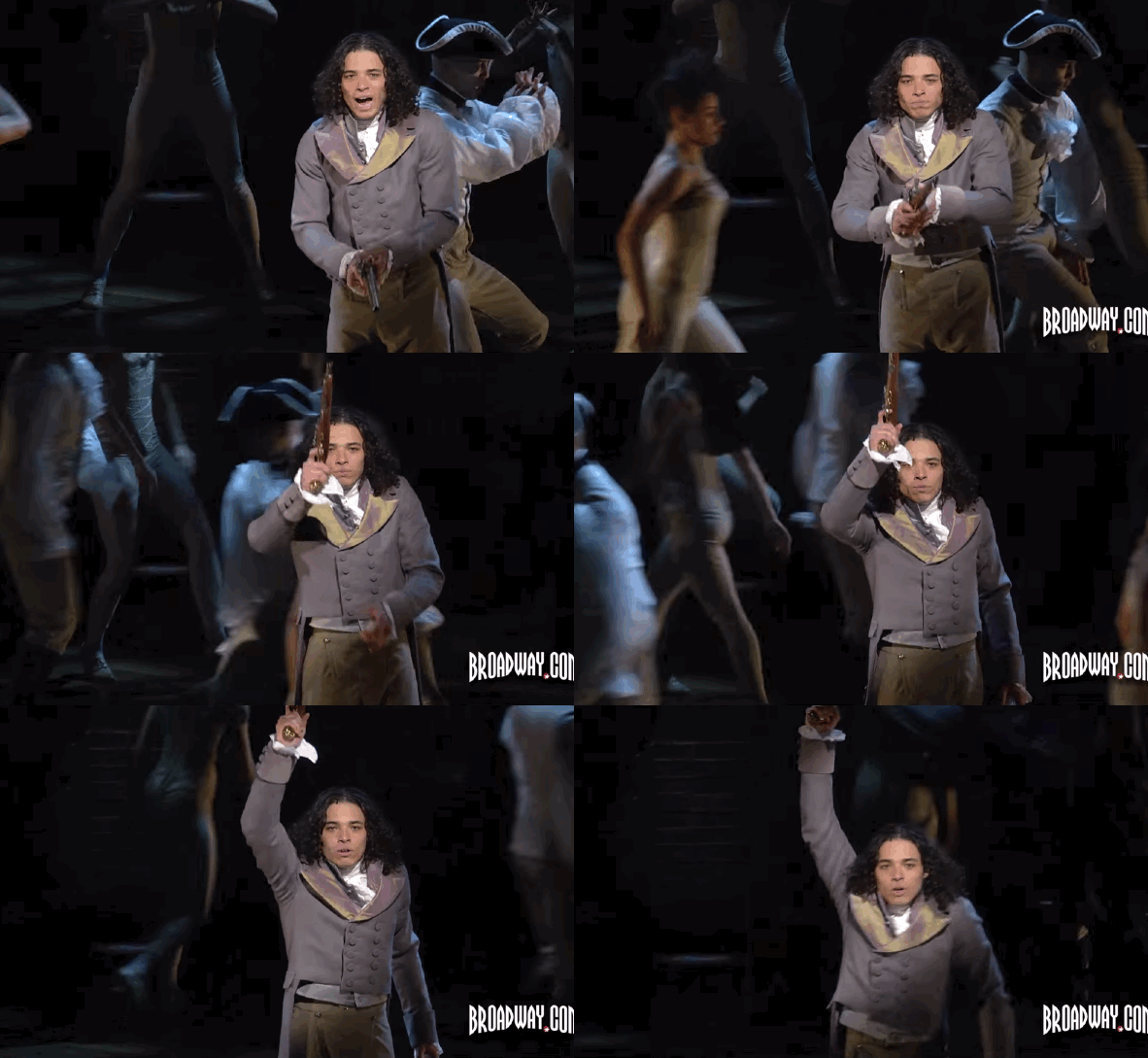
This line also directly contradicts the ninth duel commandment as previously stated. Philip first states to “aim no higher” than his opponents eye, then vies to aim for sky. This is the final indictment that will lead to Philip’s death.
Five, six,
Cutting Philip off at 7 draws our attention back to what the 10 Duel Commandments are—and what Philip does not get to do.
Seven through ten:
- Confess his sins (Philip’s status as a relative “innocent” comes into play here—he’s still a teenager at boarding school, and doesn’t have the “sins” to confess at 7)
- Negotiate one last time (Eacker pushes past the remaining ‘pleasantries’)
- Look his opponent in the eye and aim no higher (he is both fired upon early in the face-off and he aims at the sky, i.e. above his opponent’s head)
- Fire (again, the early shot)
The early shot not only literally cuts off the count, but Eacker’s eagerness cuts off the enactment of the code duello as described in “Ten Duel Commandments.”
seven
George Eacker fires at the count of seven, not ten, most dishonorably.
This is the last we see of Eacker in the play. Chernow states that Eacker was never prosecuted for Philip Hamilton’s eventual death. Alexander Hamilton wrote angry articles in his New-York Post, and called for dueling to be outlawed, but nothing came of it. Eacker died two years later of consumption.
Historically, Eacker did not fire early. In fact, according to Chernow, neither even raised their gun until a minute AFTER the command to fire was given:
At the duel, Philip Hamilton heeded his father’s advice and did not raise his pistol at the command to fire. Eacker followed suit, and for a minute, the two young men stared dumbly at each other. Finally, Eacker lifted his pistol, and Philip did likewise. Eacker then shot Philip above the right hip, the bullet slashing through his body and lodging in his left arm. In what might have been a spasmodic, involuntary discharge, Philip fired his pistol before he slumped to the ground.
Why change history? To make the duel’s outcome as shocking for the audience as it was for Hamilton. The audience knows that Philip might die, but after “Ten Duel Commandments”, they think they know the rules: Philip’s fate will be decided after “Number ten paces—fire!” Although subtly foreshadowed by Phillip harmonizing at sept (seven) earlier on, it’s still a shock when Philip is shot at seven. It’s too soon.
And that’s the point. The duel’s early ending echoes the early ending to Philip’s whole life. He’s cut down before his time is up. Capturing that feeling is more important than being historically accurate.