Back to Hamilton: An American Musical (Original Broadway Cast Recording)
The Reynolds Pamphlet
Original Broadway Cast of Hamilton

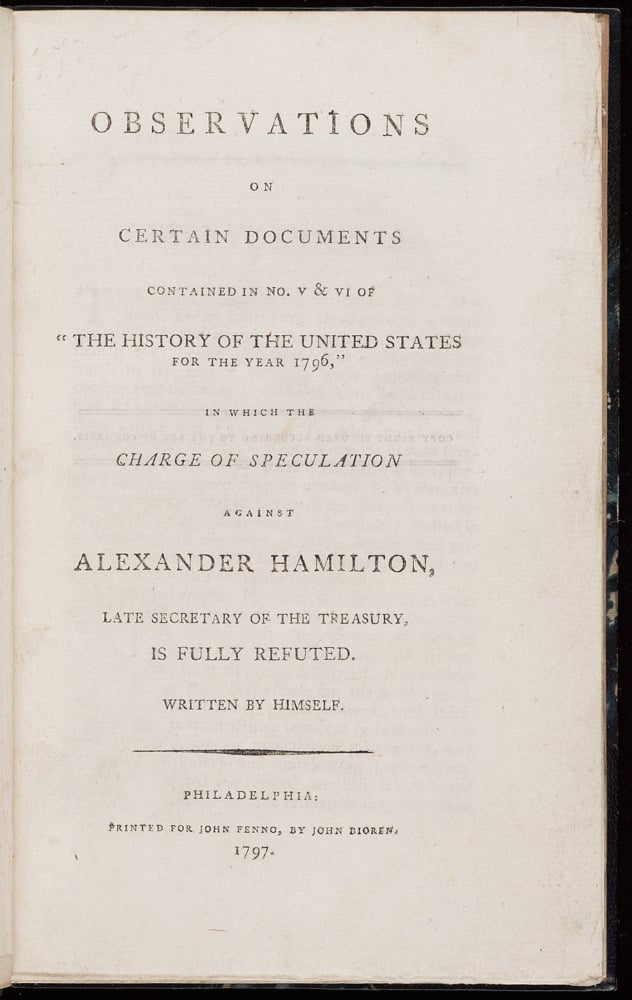
“The Reynolds Pamphlet” was a 95-page document written by Alexander Hamilton in response to allegations of corruption. He refuted these allegations, but in doing so, he publicly confessed to carrying on a three-year affair with Maria Reynolds. It was one of the first political sex scandals in American political history, and had a huge impact on Hamilton’s political career.
The bass line in this song is the same from Washington’s introduction in “Right Hand Man” when he asked for assistance, just extra slow and angry. That song gave us Hamilton’s entrance into political relevancy and greatness, and here we see his fall. The bass line itself is influenced by Eminem’s “Lose Yourself,” so there’s a thematic condemnation here that Hamilton finally blew his shot.
Overall, “The Reynolds Pamphlet” sharply deviates from the rest of the musical by referencing the trap genre. While most of the songs in the musical are inflected by 90s era East Coast and West Coast rap, it has a darker, grimier, more industrial sound, with injections of multiple (sometimes distorted—one line is even auto-tuned!) voices not unlike the vigorous vocal sampling of trap records. For example, “Hypnotize” by Young Jeezy, and “Get Low” by Waka Flocka Flame:
https://www.youtube.com/watch?v=ka9AIoRw-WU
The Reynolds Pamphlet
As we learned in “Say No To This,” Maria’s husband James was aware of the affair and was blackmailing Hamilton by threatening to spread word about the affair unless Hamilton paid him. It seems likely that Maria and James worked together to orchestrate this scheme to extort Hamilton for money.
When James was jailed for illegal speculation, he tried to implicate Hamilton in the scheme, accusing him of embezzlement. Hamilton was determined to prove he never misused government funds, so he published this pamphlet.
Another fun fact:
Some time before the publication of his pamphlet, Hamilton’s former mistress Maria Reynolds sued her husband for divorce. The attorney that guided her through that process was Aaron Burr.
Even more fun facts! During the stage play, Maria seems to look horrified by the pamphlet as does everyone else, including George Washington. Miranda may have taken some license here, as Washington never displayed anything to Hamilton during this unfortunate incidence except that he would stand in solidarity with his friend. This is evidenced by a letter sent to Hamilton by Washington during the aftermath of the pamphlet’s publication and the fact that it makes no mention of the incident at all. Martha Washington also sent a gift to he family at this time of wine chiller that remained one of Alexander and Eliza’s most prized possessions and is still on display at the Hamilton Grange, their home in Harlem. (Chernow, Ron “Alexander Hamilton”)
[JEFFERSON/MADISON/ANGELICA]
[BURR/JEFFERSON/MADISON] ⮐
Alexander Hamilton had a torrid affair
“Alexander Hamilton” is once again sung in Hamilton’s introductory motif, but it’s rendered atonal and awful here. Hamilton’s political opponents ghoulishly illustrate the fact that Hamilton has really effed-up his public image.
And he wrote it down right there
Highlights!
Madison calls for Jefferson to read the “highlights” because, like so much of Hamilton’s writing, the Reynolds Pamphlet was long. His explanation of his affair was 98 pages. As Jefferson said about another Hamilton manifesto in “Cabinet Battle #1,” “it’s too many damn pages for any man to understand.”
It also is yelled in the same way many songs yell “remix!”.
“The charge against me ⮐
Is a connection with one ⮐
James Reynolds! (James Reynolds!) ⮐
For purposes of ⮐
Improper speculation
This paraphrases a few lines from “The Reynolds Pamphlet”:
The charge against me is a connection with one James Reynolds for purposes of improper pecuniary speculation. My real crime is an amorous connection with his wife for a considerable time, with his privity and connivance, if not originally brought on by a combination between the husband and wife with the design to extort money from me.
What an elegant way to say, “I fucked a married woman, but with her husband’s consent!”
At this point in the play, Philip also comes on stage as if he needed something of his father, but backs away in surprise, as if he isn’t meant to be there. He bumps into Jefferson who turns around and shows him the Pamphlet. Philip walks away slowly in grief offstage. The fact that Philip is there makes you think how The Reynolds Pamphlet affected everyone in Alexander’s life.
My real crime is an
This paraphrases a few lines from “The Reynolds Pamphlet”:
The charge against me is a connection with one James Reynolds for purposes of improper pecuniary speculation. My real crime is an amorous connection with his wife for a considerable time, with his privity and connivance, if not originally brought on by a combination between the husband and wife with the design to extort money from me.
What an elegant way to say, “I fucked a married woman, but with her husband’s consent!”
At this point in the play, Philip also comes on stage as if he needed something of his father, but backs away in surprise, as if he isn’t meant to be there. He bumps into Jefferson who turns around and shows him the Pamphlet. Philip walks away slowly in grief offstage. The fact that Philip is there makes you think how The Reynolds Pamphlet affected everyone in Alexander’s life.
(My real crime is an)
Of course, Burr is familiar with having an amorous connection with another’s wife—he sang about it at length in the first act. His song, of course, was a private affair, and this is most decidedly not. Once again, Hamilton’s “running off at the mouth” sets him against Burr’s own philosophies.
Amorous connection with his wife
This paraphrases a few lines from “The Reynolds Pamphlet”:
The charge against me is a connection with one James Reynolds for purposes of improper pecuniary speculation. My real crime is an amorous connection with his wife for a considerable time, with his privity and connivance, if not originally brought on by a combination between the husband and wife with the design to extort money from me.
What an elegant way to say, “I fucked a married woman, but with her husband’s consent!”
At this point in the play, Philip also comes on stage as if he needed something of his father, but backs away in surprise, as if he isn’t meant to be there. He bumps into Jefferson who turns around and shows him the Pamphlet. Philip walks away slowly in grief offstage. The fact that Philip is there makes you think how The Reynolds Pamphlet affected everyone in Alexander’s life.
(Amorous connection with his wife)
Of course, Burr is familiar with having an amorous connection with another’s wife—he sang about it at length in the first act. His song, of course, was a private affair, and this is most decidedly not. Once again, Hamilton’s “running off at the mouth” sets him against Burr’s own philosophies.
For a considerable time ⮐
With his knowing consent
This paraphrases a few lines from “The Reynolds Pamphlet”:
The charge against me is a connection with one James Reynolds for purposes of improper pecuniary speculation. My real crime is an amorous connection with his wife for a considerable time, with his privity and connivance, if not originally brought on by a combination between the husband and wife with the design to extort money from me.
What an elegant way to say, “I fucked a married woman, but with her husband’s consent!”
At this point in the play, Philip also comes on stage as if he needed something of his father, but backs away in surprise, as if he isn’t meant to be there. He bumps into Jefferson who turns around and shows him the Pamphlet. Philip walks away slowly in grief offstage. The fact that Philip is there makes you think how The Reynolds Pamphlet affected everyone in Alexander’s life.
[HAMILTON/JEFFERSON/MADISON]
“I had frequent meetings with her ⮐
Most of them at my own house.”
These lines come nearly verbatim from the actual Reynolds pamphlet:
After this I had frequent meetings with her, most of them at my own house; Mrs. Hamilton with her children being absent on a visit to her father.
The only change is that “her children” from the pamphlet is changed to “our children” for the song. Perhaps LMM didn’t want stage-Hamilton be too unlikeable.
Eliza’s visit to her father was covered in “Take a Break.”
Chernow notes that Hamilton really worked to keep Eliza in Albany:
At one point, when Eliza seemed about to return on short notice, Hamilton, worried that he might be taken by surprise, exhorted her to “let me know beforehand your determination that I may meet you at New York.” In late August, when her return seemed imminent, Hamilton advised that “much as I long for this happy moment, my extreme anxiety for the restoration of your health will reconcile me to your staying longer where you are…. Think of me – dream of me – and love me my Bestsey as I do you.” Finally, in September, with Hamilton suffering from his old kidney ailment and taking warm baths to soothe it, Eliza decided to return with the children. One last time, Hamilton urged her, “Don’t alarm yourself nor hurry so as to injure either yourself or the children.”
[DEEP VOICE] ⮐
Damn!
Trap music often uses digitally-altered voices for effect.
“DEEP VOICE” is presumably the pitch-shifted version of Lin-Manuel Miranda’s voice that also appears in “The Adams Administration.”
It’s also used at the beginning of the song, underneath “Have you read this?”.
“Mrs. Hamilton with our children being absent ⮐
On a visit to her father.”
These lines come nearly verbatim from the actual Reynolds pamphlet:
After this I had frequent meetings with her, most of them at my own house; Mrs. Hamilton with her children being absent on a visit to her father.
The only change is that “her children” from the pamphlet is changed to “our children” for the song. Perhaps LMM didn’t want stage-Hamilton be too unlikeable.
Eliza’s visit to her father was covered in “Take a Break.”
Chernow notes that Hamilton really worked to keep Eliza in Albany:
At one point, when Eliza seemed about to return on short notice, Hamilton, worried that he might be taken by surprise, exhorted her to “let me know beforehand your determination that I may meet you at New York.” In late August, when her return seemed imminent, Hamilton advised that “much as I long for this happy moment, my extreme anxiety for the restoration of your health will reconcile me to your staying longer where you are…. Think of me – dream of me – and love me my Bestsey as I do you.” Finally, in September, with Hamilton suffering from his old kidney ailment and taking warm baths to soothe it, Eliza decided to return with the children. One last time, Hamilton urged her, “Don’t alarm yourself nor hurry so as to injure either yourself or the children.”
No…
This is reminiscent to “The Room Where it Happens.” There, Burr was shocked that the meeting between Jefferson, Madison, and Hamilton would decide the location of the Capitol. Here, Burr and Madison are shocked that Hamilton would take advantage of his wife and children’s absence, and possibly emphasizing that none of Hamilton’s family was in the room where it happened, or even the city where it happened, for that matter.
Boooo!
This reaction from the ensemble reflects the opinion the American public had concerning adultery in the 18th Century (as explained by other Geniuses, it is still illegal in many states, with some states only repealing these laws in the last century). And, even though Hamilton meant only to clear his name, with the language he uses, he can be interpreted as almost proud of his deception. Given both of these possibilities, it’s understandable that he lost the support of plenty of Americans who, up until the breaking of this scandal, saw him as respectable and honourable.
Have you read this?
Note that Angelica doesn’t join in with Madison and Burr and that Jefferson has dropped out. This implies that Angelica’s original “Have you read this?” was not for the purposes of spreading slander about Hamilton like Madison and Jefferson were doing, but of genuine astonishment on Hamilton’s actions.
And as always, Burr waits for the second time the phrase repeats to join in.
Well, he’s never gon’ be President now ⮐
⮐
[MADISON/BURR] ⮐
Never gon’ be President now ⮐
⮐
[JEFFERSON] ⮐
Well, he’s never gon’ be President now ⮐
⮐
[MADISON/BURR] ⮐
Never gon’ be President now ⮐
⮐
[JEFFERSON] ⮐
He’s never gon’ be President now ⮐
⮐
[MADISON/BURR] ⮐
Never gon’ be President now
Jefferson’s prayer from “Cabinet Battle #1” has been answered and this is his gloating hallelujah chorus. Needless to say, he milks it for all it’s worth:
In the stage show, as Jefferson, Madison, and Burr sing this, they are throwing copies of the pamphlet all over the stage (“making it rain,” basically), handing them to every member of the ensemble, and even reaching into the pit to hand one to musical director Alex Lacamoire. They are even joined by King George, who also dances and throws pamphlets while on the turntable stage.
Visually, it’s a hurricane of activity with Alexander standing stunned, motionless at the eye.


[JEFFERSON] ⮐
That’s one less thing to worry about ⮐
⮐
[JEFFERSON/MADISON/BURR] ⮐
That’s one less thing to worry about!
Way back in “Cabinet Battle #1” Jefferson prayed “to God we never see Hamilton’s candidacy.” His prayers were answered thanks to Hamilton’s adultery.

[ANGELICA] ⮐
I came as soon as I heard ⮐
[JEFFERSON] ⮐
What?! ⮐
⮐
[HAMILTON] ⮐
Angelica—
As Jefferson’s laughter trails off, the piano part from “Satisfied” comes in, tentative and light, announcing Angelica’s presence as she arrives. Alexander also calls out to her with her name motif, as he is wont to do whenever he gets a little too caught up in his longing for her.
The fact that the “Satisfied” motif is hesitant here is a little meta, as the audience is unsure how Angelica will react to the news of Alexander’s scandal even as we’re hearing this reminder of her private feelings for him. The piano and the audience are both asking, “Satisfied? Satisfied? Satisfied?”
This segment from Angelica is all that remains of the cut song, “Congratulations.” Lin explained in Hamilton: The Revolution (p. 235):
This was originally part of a longer tune titled ‘Congratulations.’ It came between ‘The Reynolds Pamphlet’ and ‘Burn,’ But we realized that the audience desperately wanted to see Eliza’s reaction, so I folded the best parts of it into ‘The Reynolds Pamphlet.’ I love how different it is from everything else in this section. It contributes to the feeling that the world is crashing, pathos within celebration within schadenfreude.
[COMPANY] ⮐
All the way from London?! ⮐
Damn ⮐
⮐
[HAMILTON] ⮐
Angelica, thank God ⮐
Someone who understands what I’m ⮐
Struggling here to do
Angelica DID return to the United States in 1797, the same year the Reynolds affair came to light, so this conversation is plausible.
The company’s astonishment at her coming “all the way from London” stands in stark contrast to Hamilton turning away from her after she “came all that way” to see him in “Take a Break”. At the time the transatlantic crossing was a long, difficult, often dangerous voyage. Hamilton should be very impressed that she’s willing to brave it in order to visit New York. But he’s too caught up in his own drama—first trying to get his plan through Congress, then dealing with the fallout from the Reynolds Pamphlet—to notice anyone else’s hardships.
[ANGELICA] ⮐
I’m not here for you ⮐
⮐
[ENSEMBLE] ⮐
Oooooh!

This continues a major theme of Act II: that Hamilton is not in good shape when he is alone. The “scattering” of his male friends in Act I, and the rapid disappearance of Eliza, Angelica, the children and Washington leave Hamilton without anybody to check him. Up until now someone has always been there to say, “Alexander, chill.”
Without a single friend to rein him in, Hamilton is still a buckwild kid. Many young prodigies grow up emotionally immature (it’s almost a cliche). Being the “smartest in the room” is kind of awesome when you’re 17, and gets you a lot of attention. But once you get into you’re considered “middle aged” it just makes you look overconfident. In this crisis brought on by his arrogance in his book smarts, Hamilton must have felt so relieved when an ally finally arrived–and not just any ally, but the only one who can match him intellectually.
You can’t blame Angelica for not helping him but this diss is pretty deadly to A. Ham. Angelica, his intellectual equal, the one person who he thought might understand his unorthodox solvency method, has shunned him. Her words are crafted to him in a cruel reprisal of his flirty tones and it is then that we clearly recognize Angelica as the smartest character in the musical.
But back to the original point: there are lots of people who benefit from having friends around, but Hamilton needs them.
I know my sister like I know my own mind ⮐
You will never find anyone as trusting or as kind
On the earlier song “Satisfied,” Angelica lets Eliza date Alexander despite her own feelings for him, since she knew Eliza had feelings for him as well:
I know my sister like I know my own mind
You will never find anyone as trusting or as kind
If I tell her that I love him
She’d be silently resigned, he’d be mine
She would say, “I’m fine,” she’d be lying
However, the music on “The Reynolds Pamphlet” is not as upbeat or light-hearted as it was on “Satisfied,” showing Angelica’s disappointment in Alexander. She points out that he hurt someone who believed in him even when no one else did.
I love my sister more than anything in this life
A bit of music theory terminology: to modulate is to change the key of a song. In this stanza, Angelica reprises a melody from “Satisfied” in the original key. Then, as her sentiment toughens, she modulates in line 3. You can hear she’s singing the same general melodic shape, but in lines 3 & 4, the pitches are higher than they were in lines 1 & 2. You’ll also note that the interval is bigger after she modulates (from minor third to perfect fourth).

Additionally, Angelica doesn’t let Hamilton voice his opinion here: whatever he could say in his own defense doesn’t matter. She makes her decision about whose side she’s on without getting any input from the (sometimes) love of her life.
In short, Angelica has modulated the key without debating with Hamilton. Way to use his own idea against him, Angie.
I will choose her happiness over mine every time
Thomas Jefferson once teasingly wrote to Angelica (emphasis ours):
I think I have discovered a method of preventing this dejection of mind on any future parting. It is this. When you come again, I will employ myself solely in finding or fancying that you have some faults, and I will draw a veil over all your good qualities, if I can find one large enough. I think I shall succeed in this. For, trying myself to-day, by way of exercise, I recollected immediately one fault in your composition. It is that you give all your attention to your friends, caring nothing about yourself. Now you must agree that I christian this very mildly when I call it a folly only.
Here it turns into not a folly, but one of her defining and strongest traits. It’s certainly stronger than her feelings for the philandering Alexander.
Put what we had aside ⮐
I’m standing at her side ⮐
You could never be satisfied
Whereas before the light “Satisfied” piano gave the audience a very ambiguous feeling about Angelica’s reaction, here more instruments come in as her words gain force and the music swells angrily along with Angelica’s castigation of Alexander’s betrayal of Eliza (and of her, and of their family). The theme has turned into a reprimand of Hamilton himself: “Satisfied? Satisfied? Satisfied?”
As with “Non-Stop,” where Angelica gives up Alexander as her theme dovetails into Eliza’s next verse, here she dovetails straight back into the overall theme of “The Reynolds Pamphlet,” showing musically that she’s aligned herself against Hamilton.
God, I hope you’re satisfied
[JEFFERSON/MADISON/BURR &
Well, he’s never gon’ be President now
Well, he’s never gon’ be President now
Well, he’s never gon’ be President now
That’s one less thing to worry about
That’s one less thing to worry about
[JEFFERSON/MADISON, HAMILTON, ENSEMBLE WOMEN, & ENSEMBLE MEN] ⮐
Hey! (Well he’s never gon’ be President now) ⮐
At least he was honest with our money! (Well he’s never gon’ be President now) ⮐
Hey! ⮐
At least I was honest with our money! ⮐
Well he’s never gon’ be President now ⮐
Well he’s never gon’ be President now ⮐
Hey! (Well he’s never gon’ be President now) ⮐
At least he was honest with our money! (Well he’s never gon’ be President now)
At the end of the song, there are a number of lines being sung that are simultaneous or overlap. In this we hear the following repeated refrains.
From Hamilton (and Jefferson & Madison) the line is:
Hey! At least I was honest with our money!
But the refrains sung by the ensemble overpower Hamilton’s lines:
Well he’s never gon’ be President now
This illustrates the outcomes of the Reynolds Pamphlet. Hamilton posted it to clear any charges of corruption against him or government. Most believed that he was not guilty of mishandling government funds, and some admired Hamilton’s candor. However, the dominant conversation became about what impact this would have on Hamilton’s career.
Here, Hamilton’s line also voices above the others, in volume and in pitch. Through the rise of volume, we hear Hamilton’s desperation to try and stay above the harsh judgements and speculation, but he is still drowned out by Jefferson, Madison, and the people (or ensemble) the first time they sing the line. The raised higher pitch in the second repetition of “At least I was honest with our money” effectively brings him out and above.
By doing these two things, we see many of Hamilton’s themes recurring. We see him rising up in pitch and volume and his constant fighting to be heard.
Hey! ⮐
At least he was honest with our money!

Here, Hamilton’s line also voices above the others, in volume and in pitch. Through the rise of volume, we hear Hamilton’s desperation to try and stay above the harsh judgements and speculation, but he is still drowned out by Jefferson, Madison, and the people (or ensemble) the first time they sing the line. The raised higher pitch in the second repetition of “At least I was honest with our money” effectively brings him out and above.
By doing these two things, we see many of Hamilton’s themes recurring. We see him rising up in pitch and volume and his constant fighting to be heard.
That’s one less thing to worry about
At the end of the song, there are a number of lines being sung that are simultaneous or overlap. In this we hear the following repeated refrains.
From Hamilton (and Jefferson & Madison) the line is:
Hey! At least I was honest with our money!
But the refrains sung by the ensemble overpower Hamilton’s lines:
Well he’s never gon’ be President now
This illustrates the outcomes of the Reynolds Pamphlet. Hamilton posted it to clear any charges of corruption against him or government. Most believed that he was not guilty of mishandling government funds, and some admired Hamilton’s candor. However, the dominant conversation became about what impact this would have on Hamilton’s career.
Here, Hamilton’s line also voices above the others, in volume and in pitch. Through the rise of volume, we hear Hamilton’s desperation to try and stay above the harsh judgements and speculation, but he is still drowned out by Jefferson, Madison, and the people (or ensemble) the first time they sing the line. The raised higher pitch in the second repetition of “At least I was honest with our money” effectively brings him out and above.
By doing these two things, we see many of Hamilton’s themes recurring. We see him rising up in pitch and volume and his constant fighting to be heard.
That’s one less thing to worry about!
The Reynolds Pamphlet
The harp’s introduction to Burn can be heard here. For the theory people:
The harp accompaniment heard in “Burn” is in B-minor, where the background of “The Reynolds Pamphlet” is in C-minor. These two keys are not related, and they clash even more because B and C are just a half step apart. But through the orchestration of Music Director Alex Lacamoire, these tunes mix into each other and create a smooth transition to “Burn.”
Have you read this?
At this point in the stage production, Jefferson takes a copy of the Reynolds Pamphlet and hands it to Alex Lacamoire, who pauses conducting the orchestra to break the fourth wall.

You ever see somebody ruin their own life?
[COMPANY (EXCEPT HAMILTON/ELIZA)]
His poor wife
This is a callback to the line in “Say No To This” where James Reynolds refers to Maria as “my whore wife.” Eliza and Maria have both been put into terrible positions by their husbands.
If you listen closely, the harp intro to the next track, “Burn,” can be heard seconds after the last “That’s one less thing to worry about.” What begins as triplets in the background here transitions effectively to the triple meter of the following song.
Considering how much this concerns Eliza, it is notable that she does not utter one word in this song- part of her promise to erase herself from the narrative in “Burn.”