Back to Hamilton: An American Musical (Original Broadway Cast Recording)

Schuyler Defeated

Anthony Ramos, Leslie Odom, Jr., Lin-Manuel Miranda & Phillipa Soo

Multiple motifs from “The Schuyler Sisters”—both Burr’s part and the sisters'—recur here in an arch reprise. Instead of the Schuyler family being on the pulse of politics, they’re being forced out. In “Schuyler Sisters,” Burr adopted a teasing rap style that he used in that song to talk himself up to Angelica. Now he uses it again to poke at Hamilton about his recent rise in prominence. Their brief argument marks the end of Hamilton and Burr’s (already contentious and contested) friendship. Things fall apart, and are pointedly foreshadowed. Battle lines are drawn for an increasingly vicious series of conflicts between Team Hamilton/Washington and what will soon be Team Burr/Jefferson (“Washington On Your Side”).
[PHILIP]
Look!
Grandpa’s in the paper!
“War hero Philip Schuyler

Schuyler was a general during the Revolution. While his military campaigns were not particularly successful, he was valuable in convincing Oneida, Tuscaroras, and Mohawk American Indians to join the Colonists' side. (The Iroquois had already sided with the British.)

loses senate seat to young upstart Aaron Burr”

This language is possibly borrowed from Chernow, where one picture’s caption describes Burr as “a young senator from New York, circa 1792, having replaced Philip Schuyler.”

But here’s something else that’s newsworthy to the audience: Aaron Burr being called an upstart! In a public forum, no less! This is a long way away from the Aaron Burr of “My Shot,” who said, “you keep out of trouble and you double your choices.”

Of course, this is after “The Room Where it Happens,” where Burr—impressed with Hamilton’s persistence in getting what he wants—pulled the trigger (“Click-Boom!”) and decided to go after what he wants. Here we see the results of that resolution—only a year later and Burr’s in the senate.

Grandpa just lost his seat in the senate

[ELIZA]
Sometimes that’s how it goes

[PHILIP]
Daddy’s gonna find out any minute

[ELIZA]
I’m sure he already knows

The melody here is the same as in “The Schuyler Sisters” when the sisters are talking about their father’s instructions. “Daddy” (Philip Schuyler) has become “grandpa” and now there’s a new generation talking about a new “daddy” (Alexander Hamilton). Life goes in cycles.

Compare Eliza’s super-chill reaction to this news to Hamilton’s much more belligerent response just a few lines away. Both Hamilton and Burr’s honor codes prevent them from letting a personal slight go. The women in Hamilton have different models for defusing, navigating and surviving conflict. Certainly this has to do with traditional gender roles, but Angelica, Eliza, Maria and Peggy also offer alternative problem-solving models specifically in comparison to A. Ham. Even in cases of what would seem to be irresolvable, provocative and hurtful differences (e.g. Hamilton’s divided affections), the women/sisters maintain their affectionate and peaceful relationships.

Eliza seems especially consistent in this; even in “Burn”, her understandably passionate outburst, her response seems to be for her own sake and understanding of her own emotions rather than any kind of vengeful attack on Hamilton, and ultimately she forgives him in “It’s Quiet Uptown”, in spite of his involvement in Philip’s death. Meanwhile Hamilton is all too ready to end a friendship and declare war.

After the Schuyler sisters' exhortations for Alexander to choose them over his work in “Take a Break”, a hint of a sigh and a note of weariness can be discerned in Eliza’s “I’m sure he already knows”. Of course the absent Hamilton would be on top of that sort of news.

[PHILIP]
Further down

[PHILIP & ELIZA]
Further down

They’re reading the paper, so they are literally reading “further down,” but this is also a subtle insult to the “newest senator” Burr as he is “further down” as far as being a honorable man.

This is sung to the same tune as the line “look around, look around” in The Schuyler Sisters.

[PHILIP]
Let’s meet the newest senator from New York
[ELIZA]
New York
[PHILIP & ELIZA]
Our senator
[HAMILTON]
Burr?

This is the first time Hamilton greeted Burr without a following “Sir,” signifying the point where Hamilton starts to feel animosity towards Burr.

Since when are you a Democratic-Republican?

It’s tempting to equate Jefferson’s Democratic-Republicans with the modern Democratic Party—after all, the Democrats directly descend from (a splinter of) the Democratic-Republicans—but doing so is fundamentally misleading.

The Democratic-Republicans were the party of limited federal power, rural interests, and the South—a constituency which sounds a lot more like today’s Republicans than today’s Democrats. The story of how that happened is complicated, but in brief:

Along the way, the party of slave power turned into the party of slavery reparations, while the party of Lincoln turned into the party of Confederate monuments. History is funny that way.

[BURR]
Since being one put me on the up and up again

[HAMILTON]
No one knows who you are or what you do

This is the first indication we have of Burr acting in an opportunistic manner, rather than choosing to “Wait for It”. Hamilton’s retort about Burr’s lyrical commentary is also referring back to “Talk Less, Smile More”, Burr’s recurring theme throughout the show. Hamilton is perplexed as to how Burr managed to get himself elected while continuing to not speak out on any specific political issues or openly campaigning.

Burr’s phrase “on the up and up” is actually ambiguous. The apparent meaning of “on the rise” is a relatively new development since the 1950s. Before that, it always meant “honest” or “on the level.” It’s possible, therefore, to interpret Burr as saying “becoming a Democratic-Republican made me honest again,” but surely Burr would never tell us what he’s against or what he’s for.

[BURR]
They don’t need to know me
They don’t like you

Political campaigns haven’t changed much in the last 200+ years, have they?

This also calls back to (and expresses a similar sentiment as) Hamilton’s earlier line:

They don’t have a plan, they just hate mine!

[HAMILTON]
Excuse me?
[BURR]

In the Off-Broadway version of the show, Hamilton and Burr’s exchange was slightly different:

[BURR]
Oh, Wall Street thinks you’re great
You’ll always be adored by the things you create
But upstate you’re the rascal who trades away the capital

[HAMILTON]
Wait.

[BURR]
The asshole who taxes the a-a-alcohol

[HAMILTON]
I’ve always considered you a friend

[BURR]
I don’t see why that has to end
A Senate seat was up for grabs and I took it
It’s not my fault people think you’re crooked

[HAMILTON]
You’re gonna make a fool of me through my father-in-law?

[BURR]
There’s the kid who almost shot Charles Lee in the jaw
My god, your pride will be the death of us all
Beware, it goeth before the fall.

Oh, Wall Street thinks you’re great
You’ll always be adored by the things you create

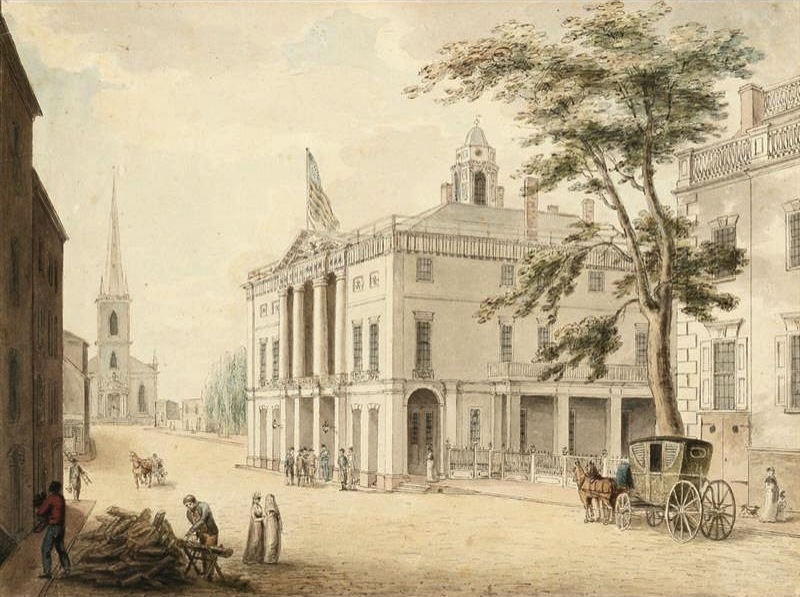
Here Burr is using “Wall Street” to mean the banks and finance industry. This may be an anachronism, since Wall Street was still a residential area at this time. Chernow notes that Alexander, Eliza and their new baby’s first house in the city was at 57 (later 58) Wall Street.

Alexander Hamilton gets his own room/exhibition at the Museum of American Finance located at 48 Wall Street, the home of the Bank of New York, which Hamilton help found. That museum is a few blocks west of Water and Wall, where the first organized trading on Wall Street happened at Merchants Coffee House in 1792. Among other things, they were trading the bonds that Hamilton convinced the US government to issue.

Wall Street in 1798, looking towards Trinity Church (where Hamilton, Angelica, and Eliza were all later buried).

Burr’s assertion that “you’ll always be adored by the things you create” is surprising, since at this time he had a teenage child. Not to mention, their country had just fought an unprecedented war of independence against the thing that created it!

But upstate—

[HAMILTON]
Wait

A subtle, but important character mark here. Hamilton attempts to invoke his “just you wait” motif on the perennially willing-to-wait-for-it Burr, who instead blithely ignores the impatient interruption.

In addition, this one-word-line rhymes with Burr’s previous lines in a way that communicates an escalation: “[words]-great-[words]-create-["but”]-upstate-wait.“ Hamilton and Burr are caught in a 2-way spiral, playing off of each other in such a way that Hamilton’s natural response (to play into and co-opt other characters' rhythms to win arguments), even when his goal is to slow things down, only accelerates things with Burr until they come to a head.

[BURR]
—people think you’re crooked

Coupled with Burr’s earlier comment on being a Democratic-Republican putting him “on the up and up again,” we neatly see Burr’s tactics as he employs them against Hamilton’s family. Burr frames himself as a righteous man across from a scheming Hamilton and his old-money elite cronies like Wall Street and the Schuyler family.

Schuyler’s seat was up for grabs so I took it

Hamilton would get his revenge, putting his father-in-law back into the Senate in 1797 after the Federalists took the NY State Senate.

[HAMILTON]
I’ve always considered you a friend

In “The World Was Wide Enough,” after Burr shoots him, Hamilton says, “Burr, my first friend, my enemy.”

[BURR]
I don’t see why that has to end

Whether Burr sees it or not, their friendship does end here. The next time we see the two interact is “We Know”, where their friendship has deteriorated to a malicious level. In the meantime, outside his direct interactions with Hamilton, Burr bad-mouths him in “Washington on Your Side.”

[HAMILTON]
You changed parties to run against my father-in-law

While it makes sense that he’d be less than happy with Burr, Hamilton’s incredulity here is also ironic. Throughout the story, Hamilton has accused Burr of standing for nothing. In “The Room Where It Happens,” he tells Burr, “You get nothing if you wait for it.” But when Burr finally stops waiting for it, Hamilton’s not happy about it.

Hamilton’s also being a hypocrite. In “The Room Where It Happens,” we see Hamilton engaging in some dubious politics and making compromises in order to get what he wants. He seizes the opportunity to get his debt plan approved by trading away the location of the capital. That said, Hamilton wasn’t really compromising his underlying principles by making this deal, while Burr’s casual switching of parties makes him seem like he has no principles.

[BURR]
I changed parties to seize the opportunity I saw

Burr’s positions aren’t held close to him, and he gladly changed his political party just to get a position in government (to get into “the room where it happens”). This lack of resolve is the very reason Hamilton doesn’t endorse him in “The Election of 1800.”

I swear your pride will be the death of us all
Beware, it goeth before the fall

The biblically-minded Burr references Proverbs 16:18, which has become a popular adage:

Pride goeth before destruction and an haughty spirit before a fall.

In other words, overconfidence in yourself often leads to your own downfall.

This is some pretty ironic foreshadowing as both Hamilton and Burr’s pride can be blamed for the duel and subsequent death of Hamilton.