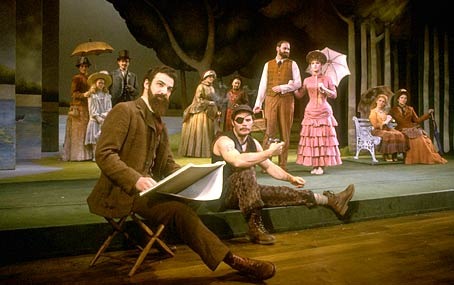
Phillipa Soo, Anthony Ramos, Lin-Manuel Miranda & Renée Elise Goldsberry
Philip reveals he’s got revolutionary potential, while Alexander, Angelica, and Eliza explore the possibility of spending some time together—their individual desires and hesitations emphasizing just how close and complicated a triangle they make.
Interestingly enough, in modern slang, to “take a break” in a relationship means to spend time apart and see others, potentially foreshadowing Alexander’s relations with Maria Reynolds.
[ELIZA &
]
Un deux trois quatre ⮐ Cinq six sept huit neuf (Un deux trois quatre)
In this song, Philip just turned nine, and so is learning to count up to nine in French. Counting to nine is also a recurring theme throughout the show, although this is the only song where it’s not used in the context of a duel (a bit of sly foreshadowing).
French was the language of diplomacy from the 17th century until the mid-20th century, and is still a working language of some international institutions.
Good! Un deux trois quatre
Cinq six sept huit neuf
(Un deux trois quatre)
Philip insists on improvising, singing a contrasting harmony instead of echoing his mother’s melody. In “Stay Alive (Reprise)”, as Philip lies on his deathbed, Eliza affectionately remembers that he “changed the melody every time.”
His insistence on changing the melody indicates his inheritance of his father’s rebellious nature.
Cinq six sept huit neuf
Philip insists on improvising, singing a contrasting harmony instead of echoing his mother’s melody. In “Stay Alive (Reprise)”, as Philip lies on his deathbed, Eliza affectionately remembers that he “changed the melody every time.”
His insistence on changing the melody indicates his inheritance of his father’s rebellious nature.
Philip insists on improvising, singing a contrasting harmony instead of echoing his mother’s melody. In “Stay Alive (Reprise)”, as Philip lies on his deathbed, Eliza affectionately remembers that he “changed the melody every time.”
His insistence on changing the melody indicates his inheritance of his father’s rebellious nature.
Philip insists on improvising, singing a contrasting harmony instead of echoing his mother’s melody. In “Stay Alive (Reprise)”, as Philip lies on his deathbed, Eliza affectionately remembers that he “changed the melody every time.”
His insistence on changing the melody indicates his inheritance of his father’s rebellious nature.
[ELIZA AND PHILIP]
One two three four five six seven eight nine!
Philip and Eliza sing to nine, and later in the song we learn that Philip has just turned nine years-old. In a way, this song functions as a measure of the time that has elapsed in Hamilton’s home life.
A bit of music theory: Eliza and Philip start singing an E major arpeggio form, but Philip “changed the line” by switching to E minor in the second instance of “sept huit neuf.” The way Philip refuses to switch back to E major symbolizes the stubbornness and persistence that he inherited from his father. The last time Philip sings the entire scale, he sings it entirely in E minor, creating a somewhat dissonant tone when melded with Eliza’s continuous E major. They sing through the entire scale each in their own keys, symbolizing Eliza conceding to the Hamilton nature of inflexibleness.
The dissonance on the word “neuf” sets up the dissonance in the song: Hamilton is being pulled in different directions by his job and his family. And despite the song’s cheerful and hopeful sound, Hamilton chooses not to “Take a Break,” and overall the song ends on a sad and ominous note.
Moreover, by switching to English for the last moment here, the meter returns to the same way the motif is performed in “Ten Duel Commandments,” really bringing home this moment’s connection to the foreshadowing inherent in this theme.
It’s also interesting to note that the melody is quite different and more intricate than it first appeared in Act I. Many motifs from Act I are either phased out, or acquire new levels of complexity in Act II.
[HAMILTON]
Right before Alexander starts to speak, we hear the same sound we hear in Satisfied right before Angelica goes back to the ball in her own perspective; after the rewind process. (Except this one is a few notes lower.)
This mirrors the way Alexander introduces himself always to the tune of his own song. (See ‘What’d I Miss’.)
This is the sound that tells you it’s about to change to Angelica’s perspective. The past few tracks haven’t included her, and this sound is a reminder that she’s still here, and watching.
My dearest, Angelica
The comma in this line later causes Angelica much consternation. Also, possibly referencing the letter that Macbeth writes to Lady Macbeth, in which he refers to the latter as “my dearest partner of greatness.”
"Tomorrow and tomorrow and tomorrow ⮐ Creeps in this petty pace from day to day"
A famous line from one of Shakespeare’s most famous soliloquies which is in turn from Act 5, Scene 5 of Macbeth. Expand below to see Lit Genius' analysis of the passage, and to hear Sir Ian McKellen offer his own breakdown.
In the play Macbeth, Macbeth says this line after he finds out his wife has died. This may be Hamilton saying that his love for only Eliza is dying and may also be foreshadowing the Reynolds affair in the next song.
I trust you'll understand the reference to ⮐ Another Scottish tragedy without my having to name the play
Hamilton was the son of a Scotsman, and so by referring to Shakespeare’s Macbeth as “another” Scottish tragedy, he is obliquely referring to himself (and in a meta-narrative sense, Hamilton itself) as a Scottish tragedy. The phrase “I’ll trust you’ll understand the reference” also serves to highlight the intellectual kinship he shares with Angelica.
Theatrical tradition holds that it is bad luck to refer to Macbeth or its titular character in a theater, instead they are typically called “the Scottish play” and “the Scotsman”, respectively. Of course, Hamilton immediately goes on to say the name anyway in the next line, illuminating the sometimes thoughtless nature of his ego, and spurring along his rapidly approaching downfall (he meets Maria Reynolds in the very next scene).
This superstition is parodied in Blackadder:
They think me Macbeth, and ambition is my folly
In Macbeth, the title character’s fatal flaw is his ambition. At the beginning of the play, Macbeth is an adored war hero—an exalted leader in a civil war (which, from the British perspective, is what the American revolution was). However, Macbeth is told by three witches that he will rise to be King of Scotland. This sets in motion a plot by Macbeth and his equally ambitious wife, Lady Macbeth, to kill the king and rule over Scotland. The play vilifies the historical Macbeth in favor of the English royal line.
The accusation that Hamilton’s true ambition is to increase his personal power is alluded to in the last scene, “Cabinet Battle #1,” when Thomas Jefferson mentions that his debt plan seems to give great power to the Treasury Department, which Hamilton heads. Hamilton may be directly referring to that dig here.
Possibly some word play here, as we don’t know exactly who is being hurt by Hamilton being “a massive pain.” First there’s the obvious interpretation of Hamilton being an obnoxious, self-righteous, loud-mouthed, all-around-grating presence to just about everyone he’s ever met.
But, as we’ve seen, Hamilton has also endured hardship after hardship to get where he is at this point. And as he told Eliza when they got engaged, one of the only things he has is “a tolerance for pain.”
Madison is Banquo
In Macbeth, Banquo is Macbeth’s loyal lieutenant who later opposes Macbeth’s claim to the throne he gained by regicide and is killed by the newly-minted tyrant.
Similarly, Madison was Hamilton’s ally in writing The Federalist Papers and lobbying for the new federal government and the Consitution. Madison wrote the most essays besides Hamilton himself, and is widely considered the father of the Constitution. However, afterwards, Madison split with Hamilton and his Federalists to found the Democratic Republicans, out of fear of the tyranny that could result from an unrestricted federal government.
,
Jefferson's Macduff
Macduff arrives in the play after Macbeth has already made his grab for power. He opposes the new tyrant and eventually overthrows him.
Similarly, Thomas Jefferson only returned from France after Hamilton had influenced the Constitution to include more powers for the central government and was here trying to oppose the putative economic tyranny of Hamilton’s debt plan.
And Birnam Wood is Congress on its way to Dunsinane
HAMILTON: And what happens if I don’t get congressional approval?
WASHINGTON: I imagine they’ll call for your removal.
While, with the previous two parallels Hamilton drew, he placed his contemporaries first and their Shakespearean counterparts second, here he mixes them up. Birnam Wood comes first and it is Congress on its way to Dunsinane. This confusion playfully exaggerates Hamilton’s analogy, as he suggests he can’t quite tell which Scottish tragedy is which.
[HAMILTON/ANGELICA]
And there you are, an ocean away ⮐ Do you have to live an ocean away?
Angelica had last visited New York in 1789, when George Washington was being sworn in. Since this song takes place in 1791, it would have been almost two years with Angelica in Europe and Alexander in the United States.
How deeply you have rooted yourself in the affections of your friends on this side the Atlantic! Some of us are and must continue inconsolable for your absence.
He added, after telling her how he and Eliza spoke about Angelica first thing in the morning and last thing at night:
But let me check, My dear Sister, these effusions of regretful friendship. Why should I alloy the happiness that courts you in the bosom of your family by images that must wound your sensibility? It shall not be. However difficult, or little natural it is to me to suppress what the fulness of my heart would utter, the sacrifice shall be made to your ease and satisfaction.
Thoughts of you subside ⮐ Then I get another letter ⮐ I cannot put the notion away…
I confess for my own part I see one great source of happiness snatched away. My affection for Church and yourself made me anticipate much enjoyment in your friendship and neighbourhood. But an ocean is now to separate us.
[ELIZA]
Take a break
The melody here is exactly the same melody as multiple phrases (such as “Benny, hey-” or “Any sign-”) sung by Nina to Benny in the song “Benny’s Dispatch” from Miranda’s 2008 musical In The Heights.
The quick back-and-forth exchange in this part of the song is also reminiscent of Nina and Benny’s exchange in “Benny’s Dispatch”.
Eliza jumps in here abruptly, interrupting the moment, seemingly reminding Hamilton who he should actually be focusing his attention on.
[HAMILTON]
I am on my way
[ELIZA]
There's a little surprise before supper
And it cannot wait
[HAMILTON]
I'll be there in just a minute, save my plate
[ELIZA]
Alexander—
When Eliza wants to get Alexander’s attention, she sings his name to the same tune as Angelica did the first time she saw him in “Satisfied” (and various other points).
[HAMILTON]
Okay, okay—
[ELIZA]
Your son is nine years old today
And he has something that he'd like to say
He's been practicing all day
Philip had been practicing all day because he wanted to impress his father. A. Ham was at this point in time absorbed in his work, so Philip most likely didn’t see him often.
Philip, take it away—
In the show, the beatboxing for Philip’s performance is provided by Eliza, in case you wanted to be even more murdered by the adorable.
Of course the supportive and nurturing Eliza is a beatboxer. In fact, the script itself acknowledges Eliza’s beatboxing as it relates to her willingness to give emotional support—the script’s stage direction at this point says “[Eliza beatboxes maternally.]” Her skill for accompaniment is also quite telling when compared to her sister Angelica’s rap solos.
You beatbox in the show. Is that something you had done before Hamilton?
I definitely did not consider myself a great beatboxer, but I’ll just stay this: The minute that they suggested that I beatbox in that scene during the rehearsals, I was so excited. That night I went onto YouTube. I think I typed in ‘female beatboxer’ or ‘incredible amazing female beatboxer.’ I went down the rabbit hole of these amazing beatboxers. That’s kind of like how I learned to sing, listening to a lot of different singers and styles of singing, and kind of just mimicked it. So, I was just sitting alone in my apartment watching these videos just making beatboxing sounds. I think my neighbors were probably like, ‘What the heck is that girl doing in there? My new neighbor is so strange.’ I had just moved into that apartment at that point.
JOHN LAURENS/PHILIP HAMILTON: Tenor, must be able to sing and rap well. […] PHILIP HAMILTON is prodigious, full of life, a wordsmith in the mold of his father Alexander. Tupac meets J. Pierrepont Finch.
In the original Broadway cast, Philip was played by Anthony Ramos.
Daddy, daddy, look—
In the show, the beatboxing for Philip’s performance is provided by Eliza, in case you wanted to be even more murdered by the adorable.
Of course the supportive and nurturing Eliza is a beatboxer. In fact, the script itself acknowledges Eliza’s beatboxing as it relates to her willingness to give emotional support—the script’s stage direction at this point says “[Eliza beatboxes maternally.]” Her skill for accompaniment is also quite telling when compared to her sister Angelica’s rap solos.
You beatbox in the show. Is that something you had done before Hamilton?
I definitely did not consider myself a great beatboxer, but I’ll just stay this: The minute that they suggested that I beatbox in that scene during the rehearsals, I was so excited. That night I went onto YouTube. I think I typed in ‘female beatboxer’ or ‘incredible amazing female beatboxer.’ I went down the rabbit hole of these amazing beatboxers. That’s kind of like how I learned to sing, listening to a lot of different singers and styles of singing, and kind of just mimicked it. So, I was just sitting alone in my apartment watching these videos just making beatboxing sounds. I think my neighbors were probably like, ‘What the heck is that girl doing in there? My new neighbor is so strange.’ I had just moved into that apartment at that point.
My name is Philip ⮐ I am a poet ⮐ I wrote this poem just ⮐ To show it ⮐ And I just turned nine ⮐ You can write rhymes ⮐ But you can't write mine
On stage, this part is incredibly funny because it is his little 9 year-old son, but the part is played by a grown man.
Throughout the musical, Hamilton raps to express himself, and hip hop is portrayed as the language of rebellion, philosophy, innovation… In the terms of the show, Philip is revealing himself to have some serious potential here, and to be a kid who wants to follow in his father’s footsteps.
By having Philip say, “you can write rhymes / but you can’t write mine,” Philip is going a little farther and revealing himself to be his father’s son: he’s ambitious to prove himself on his own terms, and to not only live up to, but surpass his father’s accomplishments. Compare how he introduces himself in “Blow Us All Away” by interpolating one of his father’s lines:
I’m only nineteen but my mind is older
Gotta be my own man, like my father, but bolder
It is also ironic when Philip says “You can write rhymes but you can’t write mine!” since he’s saying that Hamilton can’t write his rhymes, yet, as Hamilton is played by Lin Manuel-Miranda, he technically DID write his rhymes.
What!
The father-son dynamic here is quite moving, as Philip grows excited at his first rap-poem and Hamilton exclaims with pride in response. And his pride is certainly justified, given the precociously clever macaronic (bilingual) rhyme of “bank” with “cinq.”
I practice French ⮐ And play piano with my mother
The music here kicks up to show a boost in Philip’s confidence and childish spirit. It’s also a reprise of the piano scales from the song’s beginning to reflect the content Philip’s lessons.
Historically, Philip probably would have been taught by tutors rather than his mother. In fact, Chernow says:
[Eliza] Schuyler had received some tutoring but little formal schooling. Her spelling was poor, and she didn’t write with the fluency of the other Schuylers.
However, this home schooling establishes the closeness of their bond, especially in the face of Hamilton’s frequent absences for work.
(Uh-huh!)
The father-son dynamic here is quite moving, as Philip grows excited at his first rap-poem and Hamilton exclaims with pride in response. And his pride is certainly justified, given the precociously clever macaronic (bilingual) rhyme of “bank” with “cinq.”
“Philips sister, Angelica, had been extremely close to her older brother; after his death, she suffered from a breakdown and never recovered. According to Chernow, she lived until 73 but was “consigned to an eternal childhood [and] often did not recognize her family members… she sang songs that she had on the piano in duets with her father, and she always talked about her dead brother as if he was still alive.”
But I want a little brother
A bit of artistic license. By the time Philip was nine, he had two younger brothers: Alexander Jr. and James Alexander. He would eventually have five younger brothers and two younger sisters, although he never met the youngest, also named Philip.
At a Ham4Ham performance, the cast of Fun Home rapped the stories of the rest of the Hamilton children.
(Okay!)
The father-son dynamic here is quite moving, as Philip grows excited at his first rap-poem and Hamilton exclaims with pride in response. And his pride is certainly justified, given the precociously clever macaronic (bilingual) rhyme of “bank” with “cinq.”
After the Revolutionary War, the economy was in tatters: Crushing war debt weighed down the federal government, and a shortage of sound currency and bank credit stifled commercial growth. Hamilton designed the First Bank to help the government get on its financial feet and to galvanize American commerce by providing currency and loans to businesses and individuals. The bank was a vital part of a national financial infrastructure that Hamilton created during his short but prodigious career, the template for today’s monetary economy based on a stable currency and access to credit.
The father-son dynamic here is quite moving, as Philip grows excited at his first rap-poem and Hamilton exclaims with pride in response. And his pride is certainly justified, given the precociously clever macaronic (bilingual) rhyme of “bank” with “cinq.”
(Bravo!)
The father-son dynamic here is quite moving, as Philip grows excited at his first rap-poem and Hamilton exclaims with pride in response. And his pride is certainly justified, given the precociously clever macaronic (bilingual) rhyme of “bank” with “cinq.”
[ELIZA]
Take a break
The previous lines rhyme with “-ank” sounds, the next few lines have a rhyme with “-ate” sounds, and this one is a transitional piece with some of both – with some consonance, some assonance
Which fits, because Eliza’s goal in this moment is to connect Philip to his father.
[HAMILTON]
Hey, our kid is pretty great
When I hear this, I can’t help but think that Hamilton’s noticing this for the first time in nine years. “Oh yeah, I’ve been so busy trying to run America that I totally forgot I had a son. Whoops!”
[ELIZA]
Run away with us for the summer
Let's go upstate
There’s quite a bit of debate among current New York residents about what the word “upstate” really means. But given the context here, it’s clear that Eliza wants Alexander to go with her to her father’s home in Albany.
[HAMILTON]
Eliza,
I've got so much on my plate
A minor but clever pun given that just prior to supper, Hamilton said “I’ll be there in just a minute, save my plate.” Here the phrase signifies the amount of work Hamilton has to do to get his debt plan through Congress.
In mid-May 1791, knowing that Hamilton was bogged down with work, Philip Schuyler begged Eliza and the four children (plus the orphaned Fanny Antill) to join him in Albany for the summer. …Due to Schuyler’s tender concern, Eliza and the children left Philadelphia soon after… July 4 and stayed away for the rest of that torrid summer.
There's a lake I know…
[HAMILTON]
I know
[ELIZA] ⮐ In a nearby park ⮐ ⮐ [HAMILTON] ⮐ I'd love to go ⮐ ⮐ [ELIZA] ⮐ You and I can go when the night gets dark…
Echoes an exchange between Benny and Nina from Miranda’s earlier work In the Heights. They sing about finding a shady spot to relax and hanging out in Bennett Park.
[HAMILTON]
I will try to get away
[ANGELICA]
My dearest Alexander
Without the comma, noted.
You must get through to Jefferson ⮐ Sit down with him and compromise ⮐ Don't stop 'til you agree
While living in Paris, Angelica Schuyler Church befriended then-minister-to-France Thomas Jefferson. Perhaps this is why she holds out hope for her brother-in-law and her friend can come to some kind of understanding.
Off-Broadway, these lines were slightly different:
My dearest Alexander
You must get your plan to Congress
Make Jefferson a compromise, agree to disagree
Your fav'rite older sister ⮐ Angelica, reminds you ⮐ There's someone in your corner all the way across the sea
Back in the 18th century, Angelica and Alexander would be considered sister and brother, to the point that any sexual relationship between them would be considered incestuous. Gross!
Chernow believes that Adams refers to this notion of adultery in the following quote:
“[Hamilton’s] fornications, adulteries and his incests were propagated far and wide.”
Fun fact: British law banned a widower from marrying his dead wife’s sisters until 1907 because of this definition of incest.
In a letter I received from you two weeks ago
It passes you by in the blink of an eye, but this actually refers to the Macbeth letter from above. The liner notes confirm Hamilton’s rogue comma usage:
I noticed a comma in the middle of a phrase ⮐ It changed the meaning. Did you intend this?
The line is almost certainly a reference to an actual exchange between Hamilton and Angelica. In reality, though, it is Angelica who inserted a superfluous comma in a phrase in one of her letters, writing “Indeed my dear, Sir…” and Hamilton who teased her about it in a subsequent missive. Thus:
You ladies despise the pedantry of punctuation. There was a most critical comma in your last letter. It is my interest that it should have been designed; but I presume it was accidental. Unriddle this if you can. The proof that you do it rightly may be given by the omission or repetition of the same mistake in your next.
Hamilton then concludes his letter with the phrase “Adieu ma chère, soeur,” [“Farewell my dear, sister”] thereby both imitating Angelica’s punctuation error and making a cross-linguistic pun on the similarity of the words “soeur” and “sir.”
18th-century spelling and punctuation were only beginning to be standardized, and similar commas plagued not only the recipients of cheeky letters but also the judges of constitutional law. One vexing comma in the Constitution’s 2nd Amendment has sparked centuries of debate over Americans' right to own guns.
One stroke and you've consumed my waking days
A little bit of wordplay between one stroke as in ‘an especially efficacious action’ (“get them all in one stroke”), one stroke as the literal pen mark in question, and perhaps one stroke as in ‘one caress’ or ‘one compliment’ i.e. stroking the ego, since Hamilton is flirting with small morsels of tenderness here.
Apparently, this also consumed Lin-Manuel Miranda’s waking days for a few weeks:
As for waking days, we know that Hamilton has consumed her dreaming nights for some time now. With his letter, Hamilton has escalated the tension between them just as Angelica is returning to America.
It says:
[HAMILTON/ANGELICA]
"My dearest Angelica"
[ANGELICA]
With a comma after "dearest." You've written
Miranda has confirmed that this is based on letters between Angelica Schuyler and Alexander Hamilton.
Indeed my dear, Sir if my path was strewed with as many roses, as you have filled your letter with compliments, I should not now lament my absence from America
Hamilton, noticing the key comma that made him simply her “dear,” rather than her “dear sir,” responded:
You ladies despise the pedantry of punctuation. There was a most critical comma in your last letter. It is my interest that it should have been designed; but I presume it was accidental. Unriddle this if you can.
Hamilton signs this flirtatious letter “Adieu ma chere, soeur” or “Farewell my dear, sister"—inserting a vexing comma of his own.
It’s notable that the show inverts the direction of the confusion and of who is hoping for whose affection. The letters as they were historically written (with Alexander hoping Angelica was flirting with him) definitely fit the narrative of a man who was such a womanizer that he had a horny cat named after him.
[HAMILTON AND ANGELICA]
"My dearest, Angelica."
The difference between “My dearest Angelica,” and “My dearest, Angelica,” is subtle but important, and what is thrilling is how an entire world potentially hinges on the location of the comma in that phrase. In the former, the word “dearest” is acting as an adjective modifying “Angelica”. This is a common term of familiarity in letters, and while it implies affection, it could just as easily have been used for a less familiar acquaintance. (e.g., “My Dearest Mr. Jefferson, …”)
However, with a comma inserted, the phrase “my dearest” becomes a noun phrase standing alone and “Angelica” becomes an appositive that identifies that phrase, meaning that “Angelica” is “my dearest”. Unlike the idiomatic “my dearest ____”, the phrase “my dearest” by itself means exactly what it says—the one most dear to the speaker. Thus, with the comma, the sentence reads that Angelica is dearest to him in the world.
Since they both profess some romantic feelings for each other and are siblings-in-law, the change in meaning triggered by the appearance of a comma after “dearest”—assuming it was placed there intentionally—is entirely plausible and would have been distracting for the recipient. (Hence, “one stroke and you’ve consumed my waking days”.)
What’s particularly ingenious, though, about their banter and their apparent coded use of commas to convey otherwise forbidden feelings for each other, is that it also furnished deniability if the letters ever fell into the wrong hands. All they would have to do under that circumstance is brush off the incriminating comma as a little whoops—a stray mark on the page or a grammatical lapse, nothing more.
[ANGELICA]
Anyway
Almost like she’s snapped out of a trance. After fantasising about a comma, she gets back to what she was originally talking about, her visiting over summer
, all this to say
I'm coming home this summer ⮐ At my sister's invitation ⮐ I'll be there with your fam'ly ⮐ If you make your way upstate
Sorry, Hamilton. Angelica did not come home in the summer of 1791 – she was writing to Hamilton from London. In August, John Church told Alexander about Angelica’s health and good wishes, and in October, Eliza wrote Angelica:
My Hamilton and I often talk about you with great pleasure and earnestly wish that you could again be aded to our little circle but we dare scarcely hope for so great a happiness. We will not how ever dispair of Meeting again on one or the other side of the Atlantic.
My silence is caused by despair; for do not years, days and moments pass and still find me separated from those I love! Yet were I in America, would Ambition give an hour to Betsey and to me. Can a mind engaged by Glory taste of peace and ease?
[HAMILTON AND ANGELICA]
You won't be an ocean away
You will only be a moment away…
Quite literally, as Angelica actually arrives in the next line.
[ELIZA]
Alexander, come downstairs.
In the play, Alexander didn’t heed Eliza’s call to come downstairs at the top of the song, only setting aside his work after Eliza comes upstairs to fetch him. But for Angelica, he comes downstairs right away…
Angelica's arriving today!
The melody here is identical to one from Miranda’s 2008 hit musical In The Heights, repeated at various points of emotional high:
In “Blackout,” when Abuela Claudia and Usnavi sing “guard this with your life”/“this much money in my life”
Whether or not this is intentional, it demonstrates Miranda’s unique ability to blend vast genres and materials into something new, true to the spirit of hip-hop.
There’s a pause here where Peggy would once have chimed in, a subtle musical recognition of how the once close-knit sisters have been separated by marriage and time.
Peggy was also quite sick for the last few years of her life, which may help to account for her disappearance in Act II. In reality, she led quite the high-society life in Albany and was a frequent guest of the Hamiltons, until her health deteriorated. She died in 1801, just a few months before Philip.
[ANGELICA]
Alexander
The rhythm and notes sung on this line are the same as Angelica sings them at the beginning of “Satisfied,” when she first meets Alexander (and various other points in the show). The following “It’s good to see your face” mimics that song’s line “I’ll never forget the first time I saw your face,” tying this exchange back to her feelings for him that she previously revealed, and to the levels of possibility in their relationship which still existed at the beginning of that song.
[HAMILTON]
Hi
Hamilton continues the throwback to their first meeting from “Satisfied”:
[ANGELICA]
And when you said “Hi,” I forgot my dang name
The fact that a man who wrote 51 articles in the Federalist papers can only say “Hi” upon seeing Angelica after years apart speaks a thousand words. Perhaps this time, it is Angelica who makes Hamilton forget his name?
[ANGELICA]
It's good to see your face
A potential reference or a coincidental re-use, Miranda uses this exact line in In the Heights‘ “Benny’s Dispatch.” In In the Heights, Benny sings this line to (eventual love interest) Nina, who has just returned to NYC after a year away at Stanford. These circumstances are echoed by Angelica, returning to NYC after years away.
Fun Fact: Hamilton’s George Washington, Chris Jackson, also played Benny in Heights‘ original Broadway cast.
[ELIZA]
Angelica, tell this man John Adams spends the summer with his family
Adams was the first of many Vice Presidents who hated his job, writing to Abigail:
My country has in its wisdom contrived for me the most insignificant office that ever the invention of man contrived or his imagination conceived.
About fifty years later, Daniel Webster, Senator from Massachusetts, would be offered the vice-presidency and would respond: “I do not propose to be buried until I am dead.” For all the potential power to be had if the other guy dropped dead, the VP slot was not where you wanted to be if you had political ambitions.
According to The Greatest Presidential Stories Never Told by Rick Beyer, Ben Franklin once suggested that the VP be referred to as “His Superfluous Excellency.”
Here’s another moment where the word “wait” has significance. If Hamilton had listened to Eliza and Angelica, and taken a break from his work to spend some time with his family, he wouldn’t have been in the position to make the poor life choices he makes in the next song. But true to form, Hamilton doesn’t wait, he just keeps forging on.
[HAMILTON]
I'm afraid I cannot join you upstate
[ANGELICA]
Alexander, I came all this way
One of the main reasons Angelica was okay with A. Ham marrying Eliza was because his eyes would still be in her life.
Here Angelica begins to realize, as Eliza did in Act I, that Alexander marrying into the family doesn’t actually mean they get to see a lot of him.
Getting from England, where Angelica is at this time, to the U.S. was no small feat. It could take at least a month given good weather and a fast ship, and up to three or more given the opposite. So Angelica has just spent several weeks aboard a ship to come and visit for the summer for the purpose of seeing not only her blood family, but also to see Hamilton, and here he blows her off for work. Angelica could very well have died at sea, as later happened to Aaron Burr’s daughter, Theodosia , and Hamilton, while he does sound regretful, doesn’t seem to recognize the weight of what she’s done to come see him and his family.
[ELIZA]
She came all this way—
[ANGELICA]
All this way—
[ELIZA AND ANGELICA]
Take a break
[HAMILTON]
You know I have to get my plan through Congress
Hamilton’s excuses play in rigid, even rhythms, not blending at all with the sisters' light-hearted riffs. He’s also not rhyming with them anymore—in the previous verses his lines before and after “upstate” rhymed with it. At this moment, they’re in different worlds.
[ELIZA AND ANGELICA]
Run away with us for the summer
Let's go upstate
[HAMILTON]
I lose my job if we don't get this plan through Congress
Washington tells Hamilton in “Cabinet Battle #1” that if he doesn’t get enough congressional support to approve his debt plan, they’ll probably ask for his removal as Treasury Secretary.
Of course, not taking a break doesn’t do wonders for his long-term career prospects either…
[ELIZA AND ANGELICA] ⮐ We can all go stay with our father
The Schuylers come from wealth and privilege so they have had an easy life compared to Hamilton. They were raised on the understanding that you don’t have to work 24/7 just to survive. After all, the concept of a work-life balance is an invention of the middle class—the lower class knows it’s hard to have a life, period, if you don’t have any food. This means the sisters are able to see the emotional and mental benefits of taking time off, while Hamilton, influenced by his tumultuous childhood, cannot help being extremely concerned about securing his job.
Instead of choosing to stay with his family, he ends up with Maria Reynolds, as is outlined in “Say No to This.” Yet, as bad as the Reynolds affair was for Hamilton, imagine the scandal of him being caught with his wife’s sister. Perhaps he was dodging a bullet by staying away from this love triangle…
Another famous line from the Scottish play, this time Act 1 Scene 7. With it, Angelica playfully positions herself as the Lady to Alexander’s Macbeth. This may offer a bit of ironic reversal, as Lady Macbeth encouraged Macbeth’s ambitions, while Angelica is trying to temper them. Or this may also be a nod to Hamilton’s adulterous urges helping to bring about his Shakespearean downfall.
Lin-Manuel has noted that this is a reference not only to Macbeth but to “The Mob Song,” his favorite song from Disney’s Beauty and the Beast:
I actually have a ‘Screw your courage to the sticking place’ quote in Hamilton and it’s a nod to both Shakespeare and [lyricist] Howard Ashman, because that song just wrecked my life.”
You and I can go
Eliza's right—
Take a break and get away— (
)
Let's go upstate (
)
Where we can stay
If you take your time—
These lines seem to be a reassurance to Hamilton. Though he has already been warned by Washington that he will likely lose his position in government if he fails to obtain congressional approval for his financial plan—a position Eliza never wanted him to take—Angelica reminds him that he will still be able to leave a great legacy if he does. Angelica’s and Eliza’s entreaties fall on deaf ears, as Hamilton is becoming ever more obsessed with creating something that will outlive him and has a hard time handling the concept of alternatives.
The phrase “make your mark” may also be a wordplay on Hamilton’s constant writing or, more specifically, the literal mark (i.e. the comma) that caused Angelica so much turmoil upon receipt of his letter.
Moreover, “take your time” foreshadows Hamilton’s dying request to Eliza. Though he dismisses the more cautious lifestyle of Burr, it is ultimately Eliza who takes her time and makes Hamilton’s mark as much as he himself does. Conversely, it links back to the opening number’s climax, too, with the line: “You never learned to take your time!” We already know, then, that Angelica’s suggestion here is unrealistic.
Look around, look around ⮐ At how lucky we are to be alive right now—
For once this motif is invoking its origins in “The Schuyler Sisters,”, and not just Eliza’s use of it as an individual motif, as established from “That Would Be Enough.” Of course, Eliza is still trying to share with Alexander that human connection and love are the ways that she finds satisfaction. But the sisters are reunited here not only in their location, but in their passions and their excitement about the possibilities of the future (with Alexander).
(You will make your mark)
These lines seem to be a reassurance to Hamilton. Though he has already been warned by Washington that he will likely lose his position in government if he fails to obtain congressional approval for his financial plan—a position Eliza never wanted him to take—Angelica reminds him that he will still be able to leave a great legacy if he does. Angelica’s and Eliza’s entreaties fall on deaf ears, as Hamilton is becoming ever more obsessed with creating something that will outlive him and has a hard time handling the concept of alternatives.
The phrase “make your mark” may also be a wordplay on Hamilton’s constant writing or, more specifically, the literal mark (i.e. the comma) that caused Angelica so much turmoil upon receipt of his letter.
Moreover, “take your time” foreshadows Hamilton’s dying request to Eliza. Though he dismisses the more cautious lifestyle of Burr, it is ultimately Eliza who takes her time and makes Hamilton’s mark as much as he himself does. Conversely, it links back to the opening number’s climax, too, with the line: “You never learned to take your time!” We already know, then, that Angelica’s suggestion here is unrealistic.
Close your eyes and dream—
The difference between Angelica and Eliza’s lines preceding their joint “When the night gets dark / Take a break” connotes the difference in their relationship with Hamilton.
Angelica’s in particular seems to be a call back to her line in Satisfied “But when I fantasize at night / It’s Alexander’s eyes” indicating that perhaps the only time she’ll ever truly be able to express or explore her feelings for Alexander is when she’s dreaming or fantasizing, and she is calling back to this fact here.
While Eliza is telling him to come so they can go to the park and have some romantic time off they haven’t had in a while, Angelica is asking him to come so they can perhaps fantasize about what could have been. Eliza’s line focuses on her actual relationship with Alexander, whereas Angelica’s line is focused on the fantasy of what could have been that seems to pre-occupy both herself and Alexander.
Eliza and Alexander must go when it’s dark because it’s the only time they can get away from their familial duties, but Angelica and Alexander must be together when it’s dark because it’s the only way to protect the secrecy Angelica has enshrouded her feelings for Alexander in to protect Eliza (as seen in Satisfied and The Reynolds Pamphlet).
However, it’s also possible that this line could be directed towards herself instead of Alexander, once again harkening back to her original line in Satisfied, as she is resigning herself to only dreaming about what could have been with Alexander in order to protect his relationship with Eliza; if he goes to the park with Eliza, he can’t exactly be with her, and Angelica has throughout the musical held their happiness above her own.
We can go— ⮐ When the night gets dark
The sisters finally sing in unison on this line: Is Angelica’s quip about sharing Hamilton from Helpless finally coming true?
(
)
Take a break (
)
[HAMILTON]
I have to get my plan through Congress ⮐ I can't stop until I get this plan through Congress
The piano plays the melody from “Cabinet Battle #1” at this point, as a reminder that Hamilton is in the midst of battling with Jefferson and Madison to get his financial plan through Congress.