Lin-Manuel Miranda, Leslie Odom, Jr., Anthony Ramos, Christopher Jackson & Original Broadway Cast of "Hamilton"
If you needed reminding that Hamilton was barely out of his teens for the majority of the Revolution, here we have a very adolescent and daddy-issues-laden musical number.
Hamilton’s hot-blooded ambition and sensitivity to his illegitimacy clash with Washington’s cool-headed diplomacy and tendency to be thoughtlessly patronizing. This is historically accurate to the sometimes oil-and-water clash of these two very different men:
Washington was prudent and reserved, with excellent judgment. He sought conciliation and accepted compromise. Hamilton was brilliant and decisive, but prone to rashness. When he believed himself right (which was nearly all of the time), he gave no quarter and could not keep quiet.
[HAMILTON] ⮐ Lee, do you yield? ⮐ ⮐ [BURR] ⮐ You shot him in the side! ⮐ Yes, he yields! ⮐ ⮐ [LAURENS] ⮐ I’m satisfied ⮐ ⮐ [BURR] ⮐ Yo, we gotta clear the field!
Laurens is “Satisfied.” Something Hamilton and Angelica will never be.
It didn’t end quite this way. Hamilton and Major Evan Edwards, Lee’s second, wrote an account of the duel, similar to the one that William Van Ness and Nathaniel Pendleton would later write about Hamilton and Burr’s duel. They say General Lee wanted to go for a second round, since his gunshot wound was just a scratch, but Hamilton and Edwards said the duel should probably end. Laurens and Lee again said they wanted to try a second round, but this time, Hamilton and Edwards persuaded their friends to drop it. Laurens and Lee talked it out on the way back to town.
The 7/8 time signature is heard in the immediate aftermath of the duel. It only stops when Washington summons Hamilton. The time signature flows smoothly, but even the non-musical ear can sense that something is different and off-kilter, which is appropriate for the song’s events.
[HAMILTON]
Go! We won
Used but once here to mark the end of a duel, this phrase returns in much more momentous circumstances at the conclusion of “The Battle of Yorktown.”
[COMPANY]
Here comes the General!
In “Right Hand Man,” this line was sung to inspire anticipation and respect. Here, it’s more the tone of a bunch of rowdy siblings hearing their parents coming home before they’ve finished hiding the pieces of that lamp they broke.
This also reiterates the father/son-like relationship between Washington and Alexander, as emphasized later in the song.
[BURR]
This should be fun
Leslie Odom Jr.’s resigned delivery of this line reveals that Burr is bracing himself for the consequences of the duel. Although, he did not personally fight in the duel, as Laurens and Lee did, both Hamilton and him were seconds.
Alternatively, it could be interpreted as Burr relishing the chance to see Hamilton be told off. Burr is, after all, still bitter that Hamilton stole his chance for advancement. For the most part, Burr’s maxims of “Talk less, smile more” and “Wait for it” do him few favours in the musical, costing him the support of Washington and, later, of Hamilton at key points in his career.
[WASHINGTON]
What is the meaning of this?
Mr. Burr, get a medic for the General
Always diplomatic, Washington is solicitous toward Lee’s health and addresses him by his military title even though Lee had been suspended from command 4 months earlier.
The fourth of the “Ten Duel Commandments” mentions getting a doctor on site: “You pay him in advance, you treat him with civility.” So why is there no medic on site for the Lee-Laurens duel?
In the musical, this duel flouted Washington’s explicit order. The fewer people who knew (including an army medic), the better.
In the real world, the first mention of having a surgeon on site is in John Lyde Wilson’s The Code of Honor, 1838. Wilson, a Southern gentleman, wrote when the practice of dueling was fading, and those who still practiced it were trying to make dueling seem an honorable ritual (rather than murder) if the proper rules were followed. But in Hamilton’s lifetime, anyone who had honor to defend seems to have learned the procedures for dueling at his father’s knee rather than from printed dueling codes. Saving the life of the man you just shot doesn’t seem to have been a major concern. More on Wilson and other dueling codes here.
[BURR]
Yes, sir
[WASHINGTON]
Lee, you will never agree with me
This line has a double meaning. The first being its most literal: “from your perspective what I’m about to say seems impossible.” However, this is also Washington turning the other cheek toward Lee’s shit-talking, saying Lee may have inspired these young men to challenge him to a duel, but Washington didn’t sanction their actions.
But believe me, these young men don’t speak for me
Claiming ownership over one’s beliefs is a significant theme throughout the play. Compare with “Farmer Refuted,” in which the farmer says Congress doesn’t speak for him, “Take a Break,” in which Philip says Hamilton can’t write his rhymes, or pretty much anything Hamilton himself says. Over the course of the show, most of the characters spend a few lines, or even a whole song, making their stance/motivations clear to others.
Ironically, Hamilton really does speak for Washington. Being his aide, he penned letters on Washington’s behalf, speaking for him.
Thank you for your service
The same respectful line Eliza said when she met Hamilton for the first time. Here it shows Washington’s maturity and nobility in spite of Lee’s criticism of him. It also connects Eliza and Washington as strong, sensible characters—who sometimes have to deal with the folly of other people.
[BURR]
Let’s ride!
The time signature from the beginning of the song through this line is in 7/8 time. This tends to make each measure feel cut off by the next, which adds to the panic and the sense that everyone’s talking over each other.
[WASHINGTON]
Hamilton!
[HAMILTON] ⮐ Sir!
Hamilton and Washington dance around each other here both sharing and competing with their rhymes. It ends when the crux of the argument becomes Hamilton’s willingness to throw his life away; ignoring all of the people who need him (including his pregnant wife) and would be crushed if he died, and disregarding the greatness that Washington sees in him.
Examples:
[Washington] This war is hard enough
[Hamilton] Lee called you out. We called his bluff
[Washington] Allies to the south
[Hamilton] “Shot him in the mouth”
[Washington]
“Watch your tone”
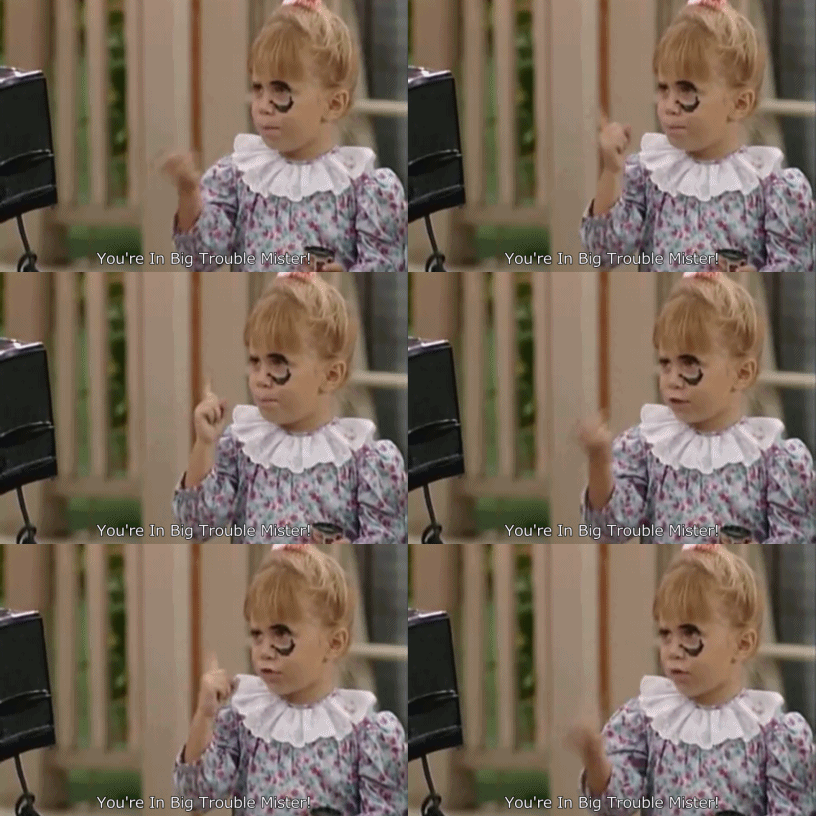
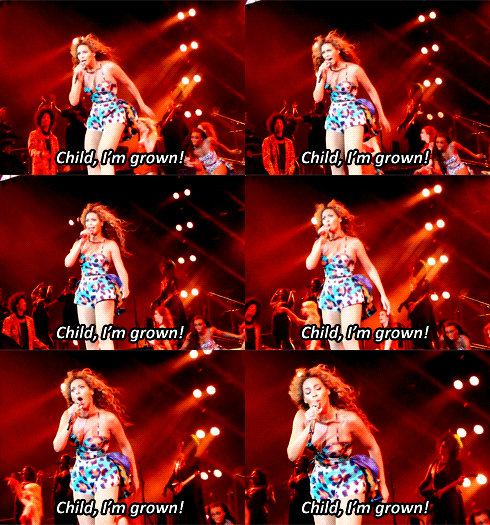
“I am grown”
[Hamilton] “They rake it”
[Washington] “I can take it”
[Hamilton]
“I don’t have your land”
“If you gave me a command”
[Hamilton] “Lead, I could fly”
[Washington] “Need you alive”
Not exactly a masterpiece, but emotions are high for both men and something had to give.
[WASHINGTON] ⮐ Meet me inside
This is where the 7/8 time ends and turns to common time. This adds to the impact of Washington’s line, to show that the time for panic is over, and he’s ready to have a very serious conversation with Hamilton. Inside.
[COMPANY]
Meet him inside! Meet him inside! ⮐ Meet him inside, meet him, meet him inside!
Refers to the repetition of “meet me outside” at the end of DMX’s “Party Up In Here.” Hamilton’s in trouble now….
The company’s repetition of this line is reminiscent of gossiping – word quickly spreads of Hamilton being caught by Washington in the duel. As Washington’s “right hand man”, the consequences for his childish actions will be worse as they reflected negatively on Washington as well.
At the end of the music video for DMX’s “Party Up In Here”, DMX’s character rappels off of the roof of a bank, in which he has been mistakenly identified as the perpetrator in a robbery. (This happens right as the “meet me outside” line is heard). Pause the video right before he reaches the ground (about 3:39) and look at the name of the bank—“United States National Bank”—the very bank Alexander Hamilton established. https://youtu.be/thIVtEOtlWM?t=3m29s
[WASHINGTON] ⮐ Son— ⮐ ⮐ [HAMILTON] ⮐ Don’t call me son
Though the working relationship between Hamilton and Washington was dynamic and potent, their personal relationship was more troubled. Washington showed Hamilton special, almost fatherly attention, affectionately calling the younger man, “my boy.” However, Hamilton was prideful, and
disliked being in a position of “personal dependence” on another man. Their contrasting temperaments prevented any close friendship from developing between the 22-year-old aide and the General, twice his age, whom Hamilton always addressed as “Your Excellency.”
Hamilton’s problem with being called “son” likely stems from his father’s absence and becoming an orphan. Hamilton’s paternity was a hot topic in the political world and the rumors were only inflamed by his opponents. Rumored fathers included Washington himself as well as Thomas Stevens, the father of Alexander’s friend Edward, who took Alexander in after his cousin committed suicide. As Chernow wrote, apparently Alexander and Edward looked strikingly similar.
While Hamilton never had a father, General Washington never had children, let alone sons.
[WASHINGTON]
This war is hard enough ⮐ Without infighting—
Infighting: Hidden conflict or competitiveness within an organization.
In this situation, Washington is particularly stressed out from this war. Even without internal conflict, (Between Laurens and Lee), the war effort is taxing. The implication here is that the duel only makes victory more difficult for the Patriots.
You solve nothing, you aggravate our allies to the south
This line implies that Charles Lee was a Virginia Lee:
Historical(Lee)ly, though this Lee did emigrate from Europe to what is now West Virginia, he was not related to that family.
However, before his post with Washington in the New York Campaign, he was the Commander of the Southern Department for the Continental Army, so Washington may be referring to their military rather than political/geographical allies here.
This is a behavior that Hamilton repeats in the Cabinet Battles, where he argues with Washington over how to treat Jefferson and Madison, both of whom are devout Southerners.
[HAMILTON]
You're absolutely right, John should have shot him in the mouth ⮐ That would’ve shut him up
Reference to another John, General John Cadwalader, who would go on to actually shoot Thomas Conway in the mouth for maligning Washington. Confirmed by Lin-Manuel in twitter:
“Founding Father” George Washington sired no children—though he was step-father to Martha Washington’s children from her first marriage. History speculates that he was sterile, possibly as an effect of contracting smallpox. His lack of biological children may explain why he informally adopted a paternal care for his young subordinates, as he does for Hamilton in this song.
That he wasn’t a biological father made it easier for him to be the allegorical father of a nation. It also retired any fears, when he was president, that the nation might revert to a monarchy, because he could have no interest in a hereditary crown.
[HAMILTON] ⮐ I’m notcha son—
Miranda references one of the myths of Hamilton’s questionable paternity that was a part of political debates into the 19th century, all of which have been proven false. As historian Sean Goudie shares in Creole America: The West Indies In The New Republic:
During his bid for reelection in 1792, mudslinging rivals resentful of Hamilton’s domineering influence over Washington’s political and economic policies accused the President of having fathered his illegitimate Treasury Secretary while in Barbados.
[WASHINGTON]
Watch your tone
I am not a maiden in need of defending, I am grown
This line could also be referring to Hamilton’s apparent inability to resist maidens who are “helpless,” a weakness that will come back with a vengeance later on in the play, when Ms Maria Reynolds walks into his life.
[HAMILTON (OVERLAPPING)]
Charles Lee,
Thomas Conway
Thomas Conway (1735 – c1800) was an officer in the Revolutionary Army. He wanted to replace Washington with Horatio Gates as commander. The existence of a letter written by Conway to Gates describing Washington as a “weak General” with “bad Councellors” was leaked to Washington. Though Conway denied writing such a letter, he offered to resign over the controversy. However, Congress—none too happy with Washington at the time—kept him on with Washington in a new position as Inspector General. Congress themselves brazenly formed a “Board of War” to oversee Washington, and openly questioned whether Washington was the best man to lead the army. Gates was appointed president of the board, and Conway reported directly to him.
Conway later discovered that it was one of his aides that had leaked the letter, and he informed Gates. Gates, apparently not the sharpest tool in the box,
wrote Washington a letter accusing someone of stealing his letters with Conway. The phrasing was suspicious, and Washington realized that Gates and Conway had been exchanging multiple correspondence because of the use of the word “letters.”
After that, the Conway Cabal, as it’s come to be known, definitively collapsed.
Conway himself was shot in the mouth in a duel, as mentioned in the above citation.
These men take your name and
they rake it ⮐ Through the mud
This line sounds an awful lot like the phrase “muckraking,” which is when someone tries to find and publicize scandalous information on someone. Just as Charles Lee and Thomas Conway did it to Washington, so will Madison and Jefferson do it to Hamilton in “We Know,” and this line in “Washington on Your Side.”
[WASHINGTON]
My name’s been through a lot, I can take it ⮐ ⮐ [HAMILTON] ⮐ Well, I don’t have your name.
Washington’s name is powerful enough on its own that people seeking scandal on him cannot tear him down enough to have any lasting impact on his career. But, as Hamilton says, he does not have Washington’s name, or the reputation that goes along with it. This also ties in with Hamilton’s repeated insistence that he isn’t Washington’s son. If he was Washington’s son, he would have his name and the fame that comes with it. Since he doesn’t, however, Jefferson’s and Madison’s muckraking can, in time, bring Hamilton to ruin.
Let’s talk about names for a bit. Washington is the 18th most common surname for African Americans, and 89% of Americans with the last name Washington are black. Jefferson is the 106th most common surname for African Americans, and 75% of Americans with the last name Jefferson are black. Why was this show cast with non-white protagonists? Because that’s what Washingtons and Jeffersons look like in modern society. Despite their personal histories of slave-ownership, many former slaves chose “Washington” and “Jefferson” as surnames to celebrate the first president of the U.S. and the author of the Declaration of Independence.
I don’t have your titles
I don’t have your land
During the Revolutionary War, in order to vote in any of the 13 colonies you had to either own land or pay a specified amount in taxes. So the fact that Hamilton had neither land nor money was a serious problem. By the time he bought land in upper Manhattan and built the Grange, the voting regulations had been changed so that 60-70% of adult white males could vote.
But, if you— ⮐ ⮐ [WASHINGTON] ⮐ No—
We know that Hamilton asked Washington for a command frequently—by this point, Washington already knows what Hamilton’s asking before he can get the words out.
In contrast to when Hamilton interrupted Washington earlier, Hamilton’s rhyme of “land” with “command” would be off-beat if not for Washington’s interjection in the middle. He’s composed his argument to anticipate his opposition and build on it- another signal to the audience of how old this argument is, how quick Hamilton’s wits are, and how unafraid he is to argue, no holds barred, even against the hero of the revolution.
[HAMILTON]
If you gave me command of a battalion, a group of men to lead, I could fly above my station after the war
This is a neat callback to Hamilton’s ambitions taking flight in “Right Hand Man”: “I’ll rise above my station, organize your information,” etc.
Here once again, Icarus is asking his father for wings. The Hamilton/Icarus comparison will go on to be made explicit in “Burn.”
“After the war” has a rhythm similar to Hamilton’s later line “after the war / I went back to New York” in “Non-Stop.” That’s Hamilton all over—always thinking five steps ahead.
This man cannot shut up to save his life. Only in his twenties here, this is at least the second time he has interrupted Washington (he also steals the spotlight from The Father in “What’d I Miss”).
[WASHINGTON] ⮐ Or you could die and we need you alive
The tone between Washington and Hamilton here is paralleled in “Blow Us All Away” when Hamilton takes on the role of concerned parent with Philip that Washington has here. Hamilton does not see the need for caution until he is faced with the possibility of death where his son is involved.
The parallel continues as we hear Washington remind Hamilton a line later that Eliza needs him alive. This is similar to Hamilton telling Philip that Eliza “can’t take another heartbreak.”
[HAMILTON]
I’m more than willing to die—
Indeed, Hamilton at times expressed a clear willingness—even a desire—to die, preferably in “brilliant” fashion as on a battlefield. In a letter to Laurens written a few years after the duel, he wrote:
I am disgusted with every thing in this world but yourself and very few more honest fellows and I have no other wish than as soon as possible to make a brilliant exit. ‘Tis a weakness; but I feel I am not fit for this terrestreal Country.
PROPOSED SUGGESTION: At his court martial, Charles Lee made a point of insulting Hamilton’s behavior on the battlefield:
Colonel Hamilton flourishing his sword, immediately exclaimed: ‘That’s right, my dear General, and I will stay, and we will all die here on this spot.’
Lee is trying to save his career by making Hamilton look young and hot-headed. His version is certainly slanted. But in mid-1778, Hamilton’s closest friends were all soldiers, for whom courage in the face of death is a requirement, and glorious death in battle is, if not a goal, at least an honorable end.
Hamilton didn’t fall in love with Eliza and become part of the Schuyler family for another 18 months – February, 1780. In one of the letters he wrote to Eliza on September 6, 1780, he said that “I was once determined to let my existence and American liberty end together. My Betsey has given me a motive to outlive my pride, I had almost said my honor….”
[WASHINGTON]
Your wife needs you alive, son, I need you alive—
This line really encompasses the whole scene’s greater truth: Hamilton feels some kinda way about the fact that Washington isn’t treating him like he’s a grown-ass man. Even though he’s now married. Don’t call him son!
However, as we learn in the next song, Washington knows Eliza is expecting a child, though Hamilton does not yet. Eliza relies on Alexander as a husband, especially considering how women were forbidden from doing so much, thanks to the 18th and 19th century society. Washington, ever responsible, keeps that in mind.
[HAMILTON]
Call me son one more time—
As previously discussed, Hamilton was not into Washington’s paternalistic attempts at personal intimacies. In a letter to his father-in-law, Hamilton denied even feeling any sense of personal friendship for Washington:
I believe you know the place I held in The Generals confidence and councils of which will make it the more extraordinary to you to learn that for three years past I have felt no friendship for him and have professed none. The truth is our own dispositions are the opposites of each other & the pride of my temper would not suffer me to profess what I did not feel. Indeed when advances of this kind have been made to me on his part they were received in a manner that showed at least I had no inclination to court them, and that I wished to stand rather upon a footing of military confidence than of private attachment. You are too good a judge of human nature not to be sensible how this conduct in me must have operated on a man to whom all the world is offering incense.
Hamilton goes on to call this troubled aspect of their relationship the “key” with which to “unlock the present mystery,” i.e. to understanding the disagreement which caused him to resign from Washington’s military staff.
In the pause after this line, the only music is a heartbeat-like electronic rhythm, echoing both Washington’s need for Hamilton’s heart to keep beating and the pounding hearts of the two arguing men. The impending tonal shift further reinforces the tense situation.
In the rest of Hamilton, Washington never again calls him “son.” They work closely again, and monumentally during Washington’s two terms as President, but this breach is never fully healed.
Apparently this line always reminds LMM of a similar line in The West Wing:
Two days ago, the General and I passed each other on the stairs ; —he told me he wanted to speak to me, —I answered that I would wait upon him immediately. I went below, and delivered Mr. Tilghman a letter … I was stopped on the way by the Marquis de La Fayette, and we conversed together about a minute on a matter of business. … Instead of finding the General, as is usual, in his room, I met him at the head of the stairs, where accosting me in an angry tone, “Colonel Hamilton, (said he,) you have kept me waiting at the head of the stairs these ten minutes ; — I must tell you, sir, you treat me with disrespect.” I replied, without petulancy, but with decision, “I am not conscious of it, sir, but since you have thought it necessary to tell me so, we part.” “Very well, sir, (said he,) if it be your choice,” or something to this effect, and we separated.
I sincerely believe my absence, which gave so, much umbrage, did not last two minutes.
The common theme between that story and this song? Hamilton’s hot-blooded nature.
It’s ironic that after asking Washington over and over to stop calling him son, Washington finally listens – only to send Hamilton home. This is really the equivalent of a parent telling a petulant child to “go to [their] room”.
That’s an order from your commander
Washington stops acting paternal and fully acknowledges that he is in charge of Alexander, because Alexander has refused to cooperate with his attempts at persuasion.
This line is reprised in “Cabinet Battle #1”, in a similar situation of Hamilton refusing to listen to Washington’s more level-headed reason, in spite of the latter’s position of greater authority.
[HAMILTON]
Sir—
[WASHINGTON]
Go home
Hamilton values his position a lot, so when Washington ordered him to go home, he tried to backtrack (“Sir–“).
In “Cabinet Battle #1”, Washington reminds Hamilton that if he does not get Congressional approval, Jefferson and Madison would probably request his removal from office. He fears this the most – being useless and being forgotten. Here, Hamilton is scared of losing his position at Washington’s side, as it threatens to ruin his dream of establishing a legacy serving his country.