Kail, the director, explained, “We needed to set up the duel between Hamilton and Burr—because you know Hamilton is going to die—so the groundwork of that, structurally, made a lot of sense to us. But having it be something so loved by hip-hop fans was also a way of saying that these folks from long ago were doing the same things that Biggie was talking about fifteen years ago.” Miranda nodded. “It’s a song about illegal activity, and how it works,” he said. “And we’re both stealing the structure from Moses.”
This duelling motif—which ultimately heralds Hamilton’s death—becomes more familiar to the listener every time it is used. We experience “imagining death so much it seems like a memory” along with Hamilton. By the time the fatal duel arrives, we could all sing along with it—not that we want to. The show uses the audience’s foreknowledge against it, creating a horrible sense of inevitable violence.
[BURR/HAMILTON/LAURENS/LEE]
Hamilton was Laurens' “second,” but Burr was not Lee’s. Major Edwards was actually Lee’s second, but as this doesn’t change the history much, we get a much more dramatically interesting substitute.
It’s the Ten Duel Commandments
This song started with a dramaturgical impulse. The audience needs to understand what dueling was like back then.
This was not drive bys. This was not heated people taking their guns out outside of bars. This is not what happens today with our gun control issues. This wasn’t beef in the same way beef is today.
It was super codified; there was a ritual about it. It was like legal arbitration — with guns. So, I came up with the idea of doing “Ten Dual Commandments” because “Ten Crack Commandments” is a how-to guide for illegal activity in the 90s. And this is a how-to guide for illegal activities in the 1790s.
In 1777, a group of Irishmen established a set of rules for dueling, titled the Code Duello. This Code contained 25 rules outlining all aspects of the duel, from appropriate times of day to receive challenges to the number of shots or wounds required for satisfaction of honor. These rules get incredibly specific, which may come as a surprise to a modern audience where dueling is perceived as brash and reckless, but at the time it was methodical and organized.
An Americanized version of the Code, written by South Carolina Governor John Lyde Wilson, appeared in 1838. Prior to that, Americans made do with European rules, with some noteworthy exceptions.
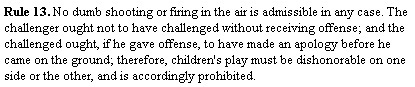
For example Rule 13 states:
Perhaps one of the reasons this song focuses on only 10 commandments of dueling, so that Hamilton’s actions in his final duel will be perceived as ultimately honorable rather than dishonorable? Also the biblical weight that 10 commandments lends to the parties' righteous indignation is too good to pass up.
Number one!
Finger cymbals sound with each rule number announcement. They are followed by bells to mimic the sound of boxing bells. The bells ring again at the end of each duel commandments.
[LAURENS] ⮐ The challenge: demand satisfaction
“Demanding satisfaction” is a well-used phrase when challenging somebody to a duel. Although the theme of satisfaction has been running through the show, this is the first time we see it used in this sense, which frankly is a relief because up until this point it’s a bit like if Titanic had gone out of its way to mention ice cubes in drinks but never mentioned an iceberg.
Tom Stoppard had a bit of fun with this particular phrase in Arcadia:
Chater: You dare to call me that. I demand satisfaction!
Septimus: Mrs Chater demanded satisfaction and now you are demanding satisfaction. I cannot spend my time day and night satisfying the demands of the Chater family.
If they apologize, no need for further action
Apologizing may not seem like a high price to pay to avoid a duel, but in the honour-conscious society of 1700s America, many found themselves unable to back down.
[COMPANY]
Number two!
The second tenet in the Ten Duel Commandments appropriately covers the choosing of one’s second, as Laurens goes on to explain.
[LAURENS]
If they don’t, grab a friend, that’s your second ⮐ ⮐ [HAMILTON] ⮐ Your lieutenant when there’s reckoning to be reckoned
Duelists always had a second, a person who would try to resolve the matter before the duel and/or replace them should they want to avoid the duel itself for any reason.
Hamilton takes over the second line because he is Laurens’s second.
The phrase “reckoning to be reckoned” in Hamilton’s line may have been influenced by a similar line in “At the End of the Day” from Les Misérables.
The choice of the word “lieutenant” is especially apt. Informally, lieutenant is used to describe a second-in-command or enforcer, but it also comes from the French for “placeholder”. Since, in certain cases, the second might be asked to stand for the principal, “placeholder” is right!
[COMPANY]
Number three!
[LEE]
Have your seconds meet face to face
In that honor-conscious society, a man couldn’t be expected to meet face-to-face and negotiate terms with someone who’d insulted him. So the duelists wouldn’t negotiate directly with each other; instead, their seconds would make the arrangements on their behalf.
[BURR] ⮐ Negotiate a peace… ⮐ ⮐ [HAMILTON] ⮐ Or negotiate a time and place
Note who offers which alternative resolution: the ever-cautious Burr advocates negotiating a peace. The hot-headed Hamilton recommends meeting on the field of honor. Burr won’t always remain so sanguine.
In reality, Burr was not Lee’s second; that honor went to Major Evan Edwards.
[BURR]
This is commonplace, ‘specially ‘tween recruits
Dueling was not quite as common as Hamilton might lead you to believe; an average of 2-3 duels occurred per year in the Colonies. However, among the honor-obsessed military elite to which Burr and Hamilton belonged, dueling was more common. To quote from The World of the American Revolution:
Duels, at least the ones we know about from the Revolutionary period, nearly always involved gentlemen serving as military officers in the Continental Army, state militias, and naval forces. Again, the evidence suggests that though dueling was common among certain classes, it was not practiced as part of everyday life.
[COMPANY]
Most disputes die, and no one shoots
An ironic line, given that in each of the three duels in the show, shots are indeed fired.
Earlier lines, even when hinting at danger, have only used words like “peace” and “apologize” and “satisfaction.”
Now, even though the meaning is ostensibly safe (most of these turn out fine), the actual words are ominous as heck—“die” and “shoots” really change the tone.
Number four!
[LAURENS]
If they don’t reach a peace, that’s alright ⮐ Time to get some pistols and a doctor on site
The lines were slightly different in the Off-Broadway version, and said by Lee rather than Laurens:
You stand firm, play your position
They’ll bring the pistols, you bring the physician
[HAMILTON]
You pay him in advance, you treat him with civility
[BURR]
You have him turn around so he can have deniability
Dueling was a widely accepted practice but officially illegal. Joanne Freeman writes in Affairs of Honor:
Many rituals prevented participants from witnessing the actual moment of gunfire – the moment when both principals became guilty of fighting a duel.
Why was this especially important? Someone with previous knowledge of a duel who failed to stop it could be prosecuted themselves. This was sort of unfair to the doctor, because he was just there to save lives. Chernow notes that an ideal surgeon should be close enough to hear people calling for help, yet “far enough away to profess ignorance.” Doctors were being advised how to avoid prosecution well into the 1830s.
Duels would usually commence at dawn, as the sun was just beginning to rise. This would give both participants a chance to think it over or sober up during the night. This also made sure that neither person had the disadvantage of the sun shining them in the eye. If they were situated north and south at sunrise, the light would be on them both equally and below eye level. Duels were also less likely to be seen in this half light, so the duelers had less of a chance of being seen or caught.
But even as it’s referencing modern music, the line is also historically accurate. Brass cartridges for bullets had not yet been invented, so the gunpowder in a pistol was exposed to the air. In damp weather, it might get wet and fail to ignite. So holding the duel somewhere “high and dry” would help ensure the guns would work properly.
Number six!
[HAMILTON]
Leave a note for your next of kin ⮐ Tell ‘em where you been.
This line prepares the audience to know what Alexander is writing in “Best of Wives and Best of Women,” so that moment can be poignant without needing explanation.
Chernow notes that both Burr and Hamilton’s letters written before their duel ended with “Adieu”.
Pray that hell or heaven lets you in
The dichotomy between sinners and saints is a recurring theme in the musical (for example, here and here). Depending upon which of these you are, you’ll need somewhere to go in case you don’t survive the duel.
Interestingly, Hamilton mentions hell alongside heaven. Given the three choices of the afterlife (heaven, hell, and purgatory), purgatory is generally preferable to hell, unless you have something against waiting….
[COMPANY]
Seven!
Considering that this is the number of the commandment about confessing sins, this can be interpreted as an allusion to the seven deadly sins.
[LEE]
Confess your sins.
The dichotomy between sinners and saints is a recurring theme in the musical (for example, here and here). Depending upon which of these you are, you’ll need somewhere to go in case you don’t survive the duel.
Interestingly, Hamilton mentions hell alongside heaven. Given the three choices of the afterlife (heaven, hell, and purgatory), purgatory is generally preferable to hell, unless you have something against waiting….
Ready for the moment ⮐ Of adrenaline when you finally face your opponent
This is not “ready,” adjective, as in ‘I’m ready,’ but rather “ready,” verb, as in ‘prepare.’
Managing your adrenaline is important to your aim, even with modern weaponry. “Adrenaline affects sight alignment which is the key to accuracy.”
The use of the term ‘adrenaline’ is anachronistic. It was coined in 1901 and the hormone (also known as epinephrine) was first coined and recognized in 1897.
[COMPANY]
Number eight!
[LAURENS/LEE/HAMILTON/BURR]
Your last chance to negotiate
Send in your seconds, see if they can set the record straight…
“Send in your seconds” means to send in your backup, but also can mean that one person will have
only a few seconds left in life. They’re technically sending in their seconds before they die.
[BURR]
At this part of the song, an ominous clock starts ticking and the turntable starts turning. This clock is used to indicate something’s going to happen. (And it’s not gonna be pretty.)
Alexander ⮐ ⮐ [HAMILTON] ⮐ Aaron Burr, sir
Hamilton addresses Burr in what has become their customary motif.Historically, Lee’s second was one Evan Edwards, who had served General Lee’s aide, and Burr was not actually involved. However, a bit of dramatic license is taken in order to make sure our pro- and antagonist “keep meeting.”
Having Burr and Hamilton face off here is a powerful narrative choice though, because technically they could end up dueling each other right now. The job of a second is to take over the fight if the duelist is killed—although, as we see, it was unlikely for the duel to continue after the first hit. It was mostly a ceremonial role by this point in history. Still, Burr and Hamilton must realize that they’ve agreed to fight each other if need be.
[BURR] ⮐ Can we agree that duels are dumb and immature? ⮐ ⮐ [HAMILTON] ⮐ Sure ⮐ But your man has to answer for his words, Burr ⮐ ⮐ [BURR] ⮐ With his life? We both know that’s absurd, sir
This is particularly ironic, as Hamilton and Burr would duel each other many years later (see “The World Was Wide Enough”), with Burr actually being the one to demand satisfaction, and to make Hamilton answer for his words with his life.
[HAMILTON]
Hang on, how many men died because Lee was inexperienced and ruinous?
Hamilton’s quick reply disrupts the rhythm. We see two other instances of this in the musical – once in “Aaron Burr, Sir” and again in “Cabinet Battle #2”.
Charles Lee could be considered responsible for the fates of 362–500 American soldiers who were killed, wounded, or captured during the loss of the Battle of Monmouth.
In reality, General Charles Lee was very experienced—so much so that he was actually expected to be named as the Commander-in-Chief of the Continental Army. Yet as we know, George Washington was tapped and Lee became the second-most senior major general instead. He never quite got over this slight and treated Washington with great disdain.
Honestly, it’s not clear that Lee’s behavior in the battle was ruinous either. Lee might have saved the lives of many revolutionary soldiers by ordering the retreat. You can read a full defense of Lee’s military tactics here.
[BURR]
Okay, so we’re doin’ this
Odom Jr.’s exasperated and resigned tone juxtaposes Hamilton’s eagerness in the previous line, painting Burr as reasonable and Alexander as overzealous and childish.
Also of note: rhyming 18th century vocabulary (“inexperienced and ruinous”) and 21st century slang (“so we’re doin' this”).
Juxtapositions like this happen throughout the show, and as a whole create a unique vocabulary for our characters that helps the audience see them in their positions in history—history being a conflation of both then and now.
[COMPANY]
Number nine!
A crucial number in the play: Philip and Eliza count up to nine both in French and English, both when he’s a kid and on his deathbed. “Nine” has better rhymes than “ten,” and it’s usually either the last number in the count or the last “normal” number before the chaos/tragedy at the end.
[HAMILTON]
Look ‘em in the eye, aim no higher
This is a restatement of Rule 13 of the Code Duello:
No dumb shooting or firing in the air is admissible in any case. The challenger ought not to have challenged without receiving offense; and the challenged ought, if he gave offense, to have made an apology before he came on the ground; therefore, children’s play must be dishonorable on one side or the other, and is accordingly prohibited.
This is revisited later when Philip duels George, in which Hamilton talks to Philip about how much courage it takes to kill, and how it doesn’t happen.
Then count
[MEN]
One two three four
[FULL COMPANY]
Five six seven eight nine
[HAMILTON/BURR]
Number
[COMPANY]
Ten paces!
Here, “Ten paces” serves two purposes in the composition of the song. Firstly, “ten” completes the “count to” two lines before it to complete the whole line as “count to … ten paces and fire!” That follows the literal action of the song and drives the plot forward.
Secondly, the ten also serves as the “Number Ten” in the tenth duel commandment as the song comes to an end. The “ten paces” refers to the set number of steps that duelers would take away from each other before turning to take aim and shoot. Although not always the same number, ten was a common, nice round number to choose. This usage of “ten paces” follows the conceit of the song as a recitation of the code duello.
Miranda compresses these two uses together into the same line, allowing him to hold the narrative tension and highlight the pleasing symmetry of a well-executed conceit, all without wasting words. And that’s how we get through 50 years of history in two and half hours, folks.
[HAMILTON/BURR]
Fire!
After/while the line is said, a gunshot is sounded, indicating Laurens shot Charles Lee, leading into “Meet Me Inside”