Thayne Jasperson, Lin-Manuel Miranda & Original Broadway Cast of "Hamilton"
Alexander Hamilton confronts a loyalist publicly advocating against the American Revolution.
The scene is inspired by a series of anonymous letters to newspapers in New England, with Bishop Samuel Seabury writing as “A Westchester Farmer” (1774) about how destructive revolution against England would be, and Hamilton responding with “A Full Vindication of the Measures of Congress” and later, “The Farmer Refuted,” (1775) from which this song takes its name. George III’s satirical nickname was “Farmer George”, so in refuting the “Farmer”, Hamilton argues simultaneously against the King’s apologist and the King.
The structure of the song is a musical pun – it makes heavy use of counterpoint, and Hamilton is making counterpoints to Seabury’s arguments. The melody is a clever variation on the classic “Minuet in G” from the “Notebook for Anna Magdalena Bach.”
This song also nods at the Amadeus scene in which Mozart’s nemesis, Salieri, painstakingly composes a simple march, and then Mozart, after hearing it once, ad libs a much more complex and sophisticated version, unintentionally humiliating Salieri in the process:
Of course, in this instance Hamilton is purposely dissing Seabury.
As with “You’ll Be Back,” the harpsichord accompaniment provides an old-fashioned feel; as with “Your Obedient Servant,” the waltz time creates an air of formality and sets the scene for an encounter of two people literally or metaphorically circling each other.
[SEABURY]
Seabury, (a. k. a., A. W. Farmer), shares a nickname with King George III (“Farmer George”)
Further, both “farmers” are the only major characters in Hamilton with English accents.
Despite these similarities, however, Seabury is clearly less formidable than King George III, seemingly imitating the King in style and tone, but not fully in substance. For instance, the accent Seabury uses in Hamilton appears forced, and if he chose to draw comparisons to George with “farmer”, he did so without acknowledgment of the fact that, in George’s case, the term was used as a pejorative by satirists.
Hear ye, hear ye!
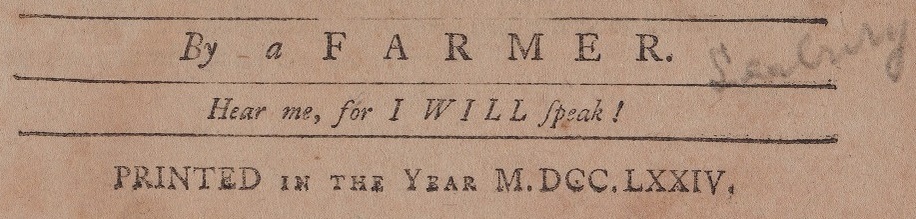
Seabury’s “Free Thoughts” have the words “Hear me, for I WILL speak!” in italics on the cover. We heard you, buddy.
My name is Samuel Seabury ⮐ And I present “Free Thoughts on the ⮐ Proceedings of the Continental Congress!”
Actually, Seabury didn’t do so badly after the War. He became the first bishop in the newly-independent American Episcopal Church (a.k.a. the Church of England, but in the US). Probably couldn’t have managed that if everyone had listened to his pamphlets.
Heed not the rabble who scream revolution ⮐ They have not your interests at heart
The American Colonies are unhappily involved in a scene of confusion and discord. The bands of civil society are broken; the authority of government weakened, and in some instances taken away: Individuals are deprived of their liberty; their property is frequently invaded by violence, and not a single Magistrate has had courage or virtue enough to interpose. From this distressed situation it was hoped, that the wisdom and prudence of the Congress lately assembled at Philadelphia, would have delivered us … But alas! they are broken up without ever attempting it: they have taken no one step that tended to peace: they have gone on from bad to worse, and have either ignorantly misunderstood, carelessly neglected, or basely betrayed the interests of all the Colonies.
The use of “rabble” here is particularly clever, as it recalls the word “rebel” and then recharacterizes the rebels as a bunch of vulgar noisemakers (the word comes from the sound of people all talking at once, or talking meaninglessly) who are beneath notice. Seabury’s snooty accent and language make it clear that he sees monarchism as upper-class and proper, and rebelliousness as lower-class and contemptible.
PROPOSED SUGGESTION: At the end of Free Thoughts, Seabury writes: “Let me intreat you, my Friends, to have nothing to do with these men, or with any of the same stamp. Peace and quietness suit you best. Confusion, and Discord, and Violence, and War, are sure destruction to the farmer.” More on Seabury’s style of argument (he relies heavily on shame and scare tactics) here.
[MULLIGAN]
Oh my God. Tear this dude apart
It’s telling that Miranda has Seabury dictate his screed with formal language and a British accent, while Mulligan (and Hamilton) respond in a more colloquial manner (“dude”, “Yo!”, etc). In reality, Hamilton was as florid, if not more, in his rebuttals as Seabury. Miranda uses the contrast here to highlight the growing schism between loyalists and patriots.
Anarchy and Confusion, Violence and Oppression, distress my country; and I must, and will speak.
Don't let them lead you astray
Seabury is trying to push the narrative that the rebels are malicious, barbaric individuals with ulterior motives, in contrast with the King who Seabury portrays as merciful and paternal.
In this line, he depicts the rebels as deceivers attempting to lead good people into the dark side.
This Congress does not speak for me
This is actually a sentiment that a lot of Americans held, both before and after the revolution. The disorder of a war and the birth of a nation are not little things, and even though many Patriots had fought to be free of British governance, several of them came to dislike and distrust the government that that replaced it just as much—which, to be fair, was brand new and had only a basic understanding of its own purpose.
[BURR]
Let him be
Burr is showing his principles here by cautioning Hamilton to wait while being reluctant to show what he’s “against or for,” despite his clear dissatisfaction with what Seabury is saying.
He reprises this sentiment much later:
In both cases, Burr is expressing disdain more than caution or compassion—he simply thinks Seabury (and, later, Hamilton) is not worth the trouble.
[SEABURY]
At this point in the song, Hamilton’s friends actually lure Burr away from Seabury so that Hamilton can verbally “tear apart” Seabury without Burr’s interference.
They're playing a dangerous game
Seabury is essentially characterizing the rebellious Americans as children who don’t know what they’re doing. The paternalistic “For shame, for shame” emphasizes this attitude.
In some ways, the Americans were behaving like brash adolescents, but they knew they needed guidance. Once George III began acting like an absent father, they looked elsewhere for leadership, and the leaders they found are today known as the Founding Fathers. It’s daddy issues all the way down.
I pray the king shows you his mercy
The Continental Congress met and worked in defiance of the British government, and took on increasing power against it. By 1776, many prominent members were wanted for—and indeed, openly committing—treason against the King of England, a criminal act punishable by death. Or more accurately, a greeeeat deal of pain, followed by a drawn out death, followed by a seizure of all your assets and the assets of your family.
The use of the religious terms “pray” and “mercy” here is a nod to the English king’s position as the head of the Church of England, and the commonly held notion that he ruled by divine right.
Much as monarchism and the Anglican religious establishment went hand in hand, the American colonial rebellion was closely tied to philosophical questions about the place of religion in politics. John Adams, a devout Protestant, was a great admirer of the 16th-century anti-monarchist John Ponet, who not only spoke out against the idea that kings ruled “by the grace of God” but also had some interesting ideas about a three-branched secular government. Adams asserted (and asked American religious leaders to preach) that “the inherent rights of mankind” came from “the Great Legislator of the Universe,” setting up the idea of a different divine right: that of self-government.
It’s also another point where the show reveals some Gilbert & Sullivan influences (the other being “Modern Major General,” which comes later). Mabel sings “For shame, for shame” in Pirates of Penzance.
[
HAMILTON
I got this idea from the Joell Ortiz’s Big Pun tribute where he basically goes in on every Big Pun tune, uses the same syllables, but tells his own story on them.
I’ve been pulling a Joel Ortiz. So if Seabury says “Heed — h e e d.” “He’d/Heed have you all unravel at the sound of screams, the revolution is comin.”
So I’m basically laying Joell Ortiz’s Big Pun tribute on top of Big Pun and which was my thinking going into this. It’s really hard to catch this in theater.
&
SEABURY
Miranda uses counterpoint in “Farmer Refuted” in a way similar to how Stephen Schwartz deploys it in “All for the Best,” from the musical Godspell.
Both numbers feature two cast members expressing starkly opposing opinions, and play up the contrast between the two characters by giving them very different musical styles and cadences. In both songs, each character’s style and tone reflects their respective roles and mindsets.
Seabury in “Farmer Refuted” and Jesus in “All for the Best” both have a slow, labored cadence, drawn-out delivery, and pedestrian musical style. Their respective opponents, Hamilton and Judas, sing at a much faster pace, in clipped voices, which allows them to fit a lot more words (and more snark/disses) into their lines.
In both songs the slower singers take what can be interpreted as the more naive and more conformist point of view and are (arguably in Jesus’s case) portrayed as being out of touch with the real world and the average person’s experience or perspective. The faster, less buttoned up singers—Hamilton and Judas—represent realism (arguably cynicism in Judas’s case), straight talk, refusal to toe the party line, nonconformity, rebellion.
Hamilton and Judas are all disses and snark, Seabury and Jesus are abstract, doe-eyed rhetoric. The lyrics, style, delivery, and choice of counterpoint come together in both songs to show just how far apart the two characters are in their thinking.
]
Yo!
He'd have you all unravel at the sound of screams ⮐ But the Revolution is comin'
When asked in 2020, just before the Hamilton film was released, if there was a lyric that resonated with him personally, given the current world events, Miranda quoted this line and added:
To me, that is the dialogue that is happening right now: of the sound of revolution, these protests that are happening. That’s the sound of change. That’s the sound of a country reckoning with what kind of country it wants to be. And that hits in a different way than it did in 2015."
The have-nots are gonna win this
It's hard to listen to you with a straight face
Chaos and bloodshed already haunt us, honestly you shouldn't even talk
Yo, pay attention to the sickening amount of sound play that Miranda/Hamilton works into this epic counterpoint takedown. Highlighted words attached to this annotation indicate just about all instances of matched consonance and assonance.
“Have-not” for ‘poor person’ was a pretty new word at the time, only having been coined in 1742 in an English translation of Don Quixote. Good word to work into the ferment for revolution, although it really sympathizes more with other more modern, less rich-white-dude-led revolutions.
Mange is a skin disease common in dogs that makes their hair fall out, making this a rather childish baldness joke (Seabury was around 30 years Hamilton’s senior). At this point, it’s clear Hamilton is getting bored one-sidedly debating with Seabury and has devolved to outright mockery, even impersonating Seabury’s over-the-top singing.
P.S. “Mercy” and “Jersey” also count.
And what about Boston? Look at the cost
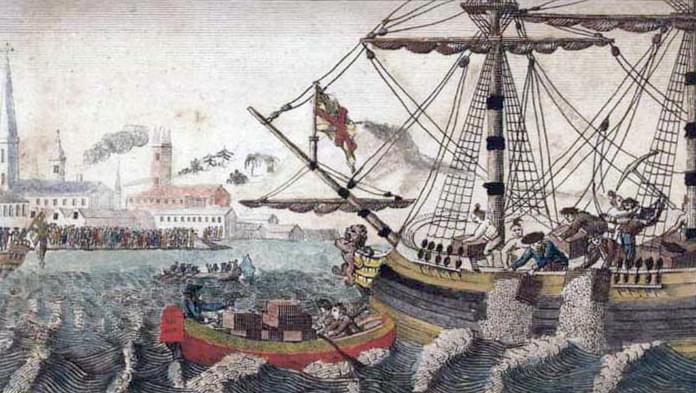
References the Boston Massacre of 1770 and the Boston Tea Party of 1773 (about nine months before Seabury’s pamphlet), and the subsequent Intolerable Acts, punitive measures set in place in Boston and throughout the colonies and Quebec between March and June 1774.
The First and Second Continental Congresses were called specifically to discuss how to respond to the British government’s increasing taxes and sanctions on the Colonies. While many delegates initially wanted to find a way to conciliate with the British Parliament, the passage of the Intolerable Acts tipped the scales.
Congress voted to retaliate rather than reconcile, establishing a trade embargo against English goods and other formal means of resistance to Great Britain, and resolved to continue meeting until the Parliament responded satisfactorily to their demands. As they did not, Congress kept it up and laid the groundwork for their eventual declaration of independence, establishing the alliance between the Thirteen Colonies, a Continental currency, and coordinating the militia.
N' all that we've lost n' you talk about Congress?!
This line, especially Miranda’s delivery of it, echoes Allen Iverson’s “We’re talking about practice?!” press conference. Another time when a cocky, super-talented upstart had no time for what he saw as the misplaced priorities of his adversaries.
My dog
Miranda says this is a reference to his dog, Tobi.
Hamilton: marries Eliza, pines for Angelica, … names a dog after Peggy.
speaks more eloquently than thee
When Hamilton says this, keen-eared listeners will be able to hear quiet, yelp-like noises. These are Hamilton’s buddies—Lafayette, Mulligan, and Laurens—barking along with his epic diss!
But strangely, your mange is the same
I pray the king shows you his mercy
The Continental Congress met and worked in defiance of the British government, and took on increasing power against it. By 1776, many prominent members were wanted for—and indeed, openly committing—treason against the King of England, a criminal act punishable by death. Or more accurately, a greeeeat deal of pain, followed by a drawn out death, followed by a seizure of all your assets and the assets of your family.
The use of the religious terms “pray” and “mercy” here is a nod to the English king’s position as the head of the Church of England, and the commonly held notion that he ruled by divine right.
Much as monarchism and the Anglican religious establishment went hand in hand, the American colonial rebellion was closely tied to philosophical questions about the place of religion in politics. John Adams, a devout Protestant, was a great admirer of the 16th-century anti-monarchist John Ponet, who not only spoke out against the idea that kings ruled “by the grace of God” but also had some interesting ideas about a three-branched secular government. Adams asserted (and asked American religious leaders to preach) that “the inherent rights of mankind” came from “the Great Legislator of the Universe,” setting up the idea of a different divine right: that of self-government.
Is he in Jersey?
This is just a smartass rebuke to Seabury who says “I pray the king shows you his mercy.”
Oh is he coming here? ‘Cause he’s an ocean away? This is Hamilton saying: they can’t touch us. We gotta fight for freedom. We’re over here.
Meaning, “What, is the king here?” Implying, “What’s he going to do to me all the way from England?” Asking if the king is specifically in Jersey may be a typical New Yorker’s dig at Jersey—to them it’s one of the most undesirable places to be on the planet because of its comparative wealth of malls, spray-tanning, and suburban mores. (That’s why this line gets a huge laugh in the theater.)
Jersey is also the site of the duels later on in the musical. So possibly there’s also a subtle, treasonous symbolism here, as if Hamilton is challenging the King himself, reminding us that the revolutionaries are willing to fight with their lives on the line.
For the Revolution
[COMPANY] ⮐ For the revolution!
This is the first time throughout the whole song the company has echoed Hamilton’s voice.
It is argued among historians that “The Farmer Refuted” was not widely known amongst the common American citizens of the time, though an intimate circle of influential men gave the essay some attention. It was also circulated by some papers across the colonies.
This small outburst from the company is representative of the small bit of attention Hamilton received from the public for the essay. It is another way to show that Hamilton’s popularity is, in a minor way, growing even further.
[SEABURY]
Heed—
[HAMILTON]
If you repeat yourself again I'm gonna—
[SEABURY/HAMILTON]
Scream—
[HAMILTON]
Honestly, look at me, please don't read!
[SEABURY]
Not your interests—
Where previously Hamilton and Seabury were talking past each other, here Hamilton is now effectively “shouting down” Seabury, whose words have become tremulous and halting.
[HAMILTON]
At this point in the stage show, Hamilton jumps up on Seabury’s literal soap box to be physically on the same level with him while he’s also competing with him verbally.
Don't modulate the key then not debate with me!
In a rare breaking of the fourth wall, Hamilton makes a clever reference to what just happened in the instrumentation at the beginning of the third verse: the music modulated up a half-step.
The three verses may reference the fact that Seabury wrote three Farmer’s letters total in response to the Continental Congress. Hamilton wrote “Farmer Refuted” (the title of the song and his letter) after the third, and there was no further response from Seabury.
Why should a tiny island across the sea regulate the price of tea?
This references the Tea Act, which was what the Boston Tea Party was all about.
The whole law around tea was a ploy to get the colonists to accept the legitimacy of paying a tax to London that they hadn’t voted for.
This line also references Thomas Paine’s Common Sense, in which he says:
Small islands not capable of protecting themselves, are the proper objects for kingdoms to take under their care; but there is something very absurd, in supposing a continent to be perpetually governed by an island. In no instance hath nature made the satellite larger than its primary planet, and as England and America, with respect to each other, reverses the common order of nature, it is evident they belong to different systems: England to Europe, America to itself.
[BURR]
Alexander, please!
This is one of Burr’s many pleas during the show for Hamilton to Talk Less, Smile More.
[HAMILTON]
Burr, I'd rather be divisive than indecisive, drop the niceties
Hamilton accosting Burr once again for trying to hide his opinion. This is similar to the line “I will not equivocate on my opinion, I have always worn it on my sleeve” from the later “Your Obedient Servant.”
This also anticipates Charles Lee’s line about George Washington “Stay Alive”:
Silence! A message from the King! ⮐ A message from the King!
This also serves as a lead-in to George III’s “break-up ballad” that comes next in You’ll Be Back, giving it the form of a direct address to his subjects in the colonies.
In every stage of these Oppressions We have Petitioned for Redress in the most humble terms: Our repeated Petitions have been answered only by repeated injury. A Prince whose character is thus marked by every act which may define a Tyrant, is unfit to be the ruler of a free people.
[FULL COMPANY]
A message from the King!
This also serves as a lead-in to George III’s “break-up ballad” that comes next in You’ll Be Back, giving it the form of a direct address to his subjects in the colonies.
In every stage of these Oppressions We have Petitioned for Redress in the most humble terms: Our repeated Petitions have been answered only by repeated injury. A Prince whose character is thus marked by every act which may define a Tyrant, is unfit to be the ruler of a free people.